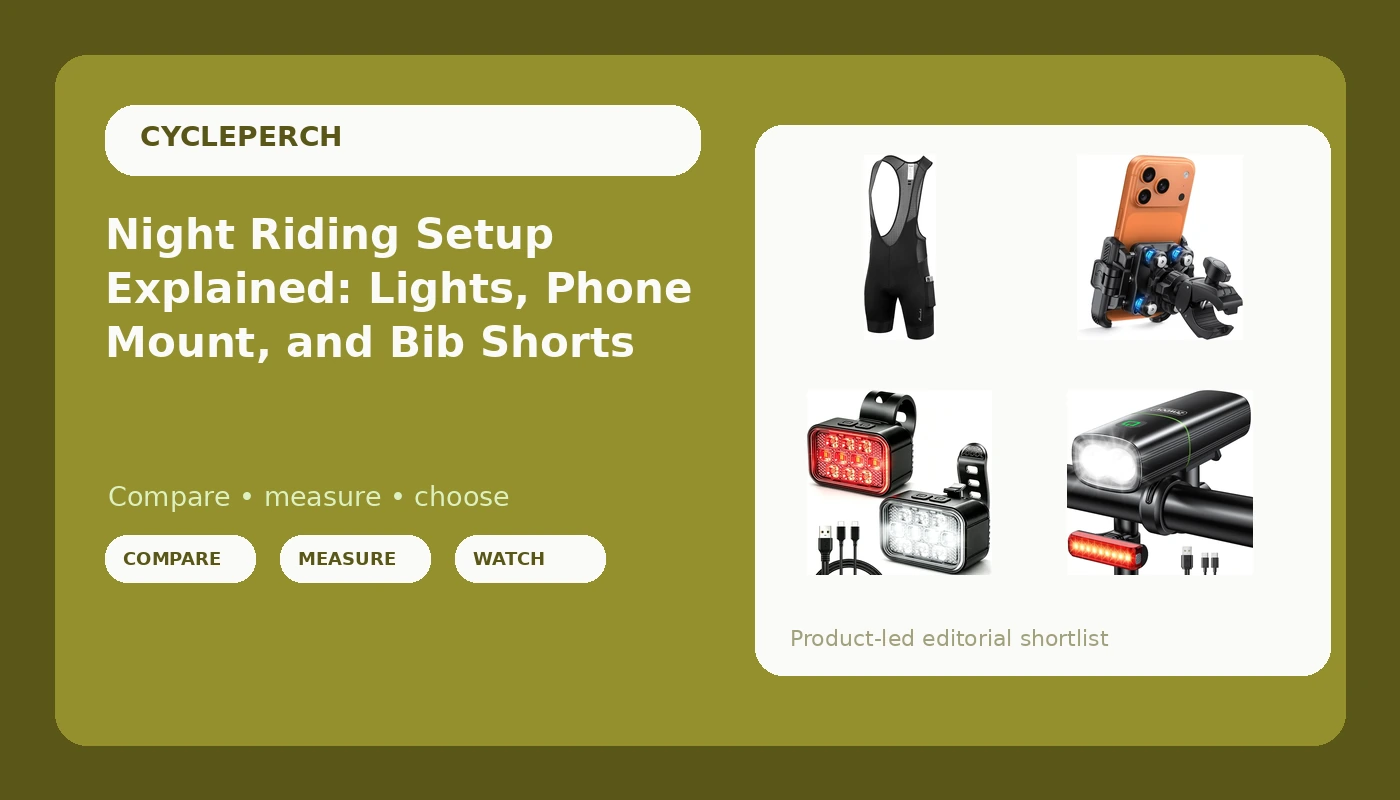
Night riding is where gear gets honest. The road does not change after dark, but everything you cannot see becomes a decision you have to make in advance. Most night riding bike lights are sold on a single number printed on the box, and that number rarely survives contact with an unlit road, a cold morning, or a wet commute home. The same logic runs through the rest of the kit: a phone mount that holds fine on smooth pavement and gives up on washboard gravel, a pair of bib shorts that feels fine for twenty minutes and turns into a problem at hour three. This explainer covers four pieces that approach the same problem from different angles, two light sets, a handlebar phone mount, and a pair of padded bibs, and walks through what each one is actually for, where inexpensive versions tend to fail, and how to decide what belongs on your bike.
Related: Commuter Bike Setup: Fenders, Lights, and the Winter Rebuild →
Quick answer
Match the light to your darkest regular ride, not your brightest ambition. If your route is lit streets at commuting speed, a USB rechargeable front and rear set with several modes and a water-resistance rating covers the job. If you ride unlit roads or paths, prioritize output and beam shape, and treat every lumen figure on a box as a manufacturer claim until you have compared it against a light you already trust. Then handle the two pieces riders forget: a mount that will not drop your phone, and shorts that will not ruin the back half of a long ride.
Four useful options
| Model | Best fit | What stands out |
|---|---|---|
| Przewalski Men's Cycling Bib Shorts, 4D Padded Bike Bibs with 2 Pockets | Riders logging longer saddle time | 4D padded chamois plus two integrated pockets |
| Lamicall Motorcycle Bike Phone Mount with Upgrade Vibration Dampener | Bars that need to hold a phone steady | Vibration dampener and a clamp meant for bike and motorcycle bars |
| Victoper 10 LED Bike Light, 8+9 Modes USB Rechargeable Bicycle Lite, High Lumens Super Bright Bike Headlight & Taillight Set, Waterproof Safety Bike Front & Rearlight for Road, Night Riding | Commuting and lit-street riding | Front and rear lights in one set, 10 LEDs, 8 plus 9 modes |
| Zewdov 1200LM Bike Lights for Night Riding with 2 Ultra Bright LED, 2600mAh USB Rechargeable Bike Light, 3+5 Modes & IP65 Waterproof Bicycle Lights Front and Rear for Men Women Cycling Electronics | Riders who want more claimed output and a bigger battery | 1200LM claim, 2600mAh rechargeable battery, IP65 rating |
The contact layer: Przewalski Men's Cycling Bib Shorts, 4D Padded Bike Bibs with 2 Pockets
Here is the honest limit of any chamois: padding cannot fix a saddle that is the wrong width for your sit bones, and it cannot fix a position that puts too much weight on soft tissue. What good shorts can do is hold a consistent pad density where you need it and stay put while you pedal, so the pressure is spread the same way at kilometer 80 as it was at kilometer 5. Sizing matters more than most riders expect, because a pad that shifts is a pad that chafes. Wash them after every ride, air dry rather than tumble dry, and rotate two pairs if you ride most days, since foam compresses over time and no chamois lasts forever.
The cockpit: Lamicall Motorcycle Bike Phone Mount with Upgrade Vibration Dampener
The mount is the piece most riders buy last and regret first. Rubber-strap mounts are the classic failure: they work on a bike path and let go the first time you hit a pothole at speed, and the phone is the expensive part of that equation. A clamped mount with a dampener addresses both problems, but check two things before you trust it. First, confirm the clamp range covers your bar diameter, since drop bars and flat bars are not the same size. Second, check the hardware after the first few rides and re-tighten to the manufacturer's spec. Vibration dampening helps with the chatter that bars transmit, but no mount makes a phone immune to every surface, so a phone you cannot afford to replace belongs in a pocket on the roughest days.
The budget set: Victoper 10 LED Bike Light, 8+9 Modes USB Rechargeable Bicycle Lite, High Lumens Super Bright Bike Headlight & Taillight Set, Waterproof Safety Bike Front & Rearlight for Road, Night Riding
Two things decide whether an inexpensive light set earns its place. The first is the bracket, not the emitter. Plastic brackets that clamp with a thin screw strip their threads within a season, and a light that flops downward mid-ride is worse than no light because you stop trusting it. Check the mount, and if it uses a bolt, tighten it to spec rather than by feel. The second is runtime at the setting you will actually use, which is almost never the brightest mode. Most sets run the longest on a flashing or low mode and the shortest on maximum output, so a light with a big mode count is really a light with a big range of runtimes. Charge it fully, then run the mode you commute in until it dies, once, so you know your real number before it matters.
The rechargeable set: Zewdov 1200LM Bike Lights for Night Riding with 2 Ultra Bright LED, 2600mAh USB Rechargeable Bike Light, 3+5 Modes & IP65 Waterproof Bicycle Lights Front and Rear for Men Women Cycling Electronics
The number in the product name is a claim, not a certificate. Lumens measure total light output in every direction the emitter throws, so two lights with the same figure can put wildly different amounts of light on the road depending on the reflector and lens. A focused beam that puts light 15 meters ahead is more useful at speed than a wide flood that lights your front wheel. Battery capacity is the part that usually holds up, because milliamp hours are harder to fudge than lumens: a larger cell means longer runtime and a longer charge, and cold weather cuts usable capacity on any lithium pack, so a light that lasts a full commute in July may not last the same commute in January. That is worth knowing before your first cold ride, not during it.
Prices and availability may change. Product images, names, and retailer links are matched to verified listings. No current price, rating, stock status, or measured result is stated here without current evidence.
What a lumen number on the box does and does not tell you
Lumens are a measure of total emitted light, and that is all they are. They say nothing about beam shape, which is the part you feel on the road: a narrow, well-shaped beam at moderate output often reads better than a wide wash at a higher number, because your eyes adapt to the brightest thing in view and everything outside that pool goes dark. They also say nothing about runtime, because output and battery draw scale together. A light rated for a big number at maximum output will hold that setting for a short time and then either dim or die, which is why mode counts matter more than they look. The low and flashing modes are not filler; they are where the runtime lives.
Water resistance ratings are similarly specific. An IP65 rating means dust-tight and protected against directed water jets, which is a real step above splash resistance and comfortably ahead of an unrated housing. It does not mean submersible, and it does not guarantee that the charge port cover stays seated if you never push it closed. Cold is the other variable no box number captures. Lithium cells lose usable capacity as temperatures drop, so a winter commuter should plan for a shorter runtime than a summer one and charge indoors rather than in a cold garage. The practical move is to know your light's real runtime on your real setting before you need it, and to carry a small backup on any ride where a dead light means an unlit road.
How to match night gear to the ride you really do
- Write down your darkest regular route and the speed you ride it. A lit commuter corridor and an unlit rural road are different problems, and the answer changes with them.
- Decide front output and beam shape before you look at mode counts, then check runtime on the setting you will actually leave it in.
- Confirm the mount hardware matches your bar diameter and inspect it after the first few rides, re-tightening to the manufacturer's torque spec.
- Choose the rear light for visibility at distance rather than brightness up close, since being seen early is the whole job of a taillight.
- Fit the body-contact pieces last. Chamois and mount ergonomics are what you notice at hour three, long after the spec sheet stops mattering.
Practical guidance for the first 100 km
- Charge every light fully before the first ride and time the mode you plan to use, so you have a real runtime figure instead of a claimed one.
- Re-check every bracket bolt after the first three rides, then monthly, because vibration loosens hardware that felt tight on the stand.
- Keep the charge port cover seated and rinse road salt off the housing in winter, since salt and grit do more damage than rain.
- Wash bib shorts after every ride and air dry them, and keep two pairs in rotation if you ride most days.
- Carry a small backup light on any route where a failure means riding unlit, and keep your phone mount hardware snug rather than merely tight.
Which option should you choose?
Choose the Przewalski Men's Cycling Bib Shorts, 4D Padded Bike Bibs with 2 Pockets when your rides are getting long enough that contact points, not fitness, are the limiting factor, and you want pockets on the bib rather than in a jersey. Choose the Lamicall Motorcycle Bike Phone Mount with Upgrade Vibration Dampener when you navigate from the bars and want a clamped mount with dampening instead of a stretchy strap holding an expensive phone. Choose the Victoper 10 LED Bike Light, 8+9 Modes USB Rechargeable Bicycle Lite, High Lumens Super Bright Bike Headlight & Taillight Set, Waterproof Safety Bike Front & Rearlight for Road, Night Riding when you ride lit streets and want one purchase to cover both ends of the bike. Choose the Zewdov 1200LM Bike Lights for Night Riding with 2 Ultra Bright LED, 2600mAh USB Rechargeable Bike Light, 3+5 Modes & IP65 Waterproof Bicycle Lights Front and Rear for Men Women Cycling Electronics when you want a larger battery and a higher claimed output for darker routes and longer commutes.
One caveat on all of it: output claims, mode counts, and water-resistance ratings are manufacturer specifications, and the only way to know how a specific unit performs on your route is to run it yourself on the modes you use. Fit items like shorts and mounts are even more personal, because bar diameter and body geometry vary from rider to rider. Buy the piece that matches your regular ride, then measure it in use.
The bottom line
Night riding rewards the boring decisions. A light set that fits your darkest regular route, mounted with hardware you actually tightened, a phone that stays clamped to the bars, and shorts that hold their pad where it belongs will do more for your riding than any single upgrade. Start with the light, because visibility is the one thing you cannot compensate for, then fix the contact points and the cockpit. If you are unsure between the two light sets here, the honest answer is that the difference lives in battery capacity and claimed output, and the way to settle it is to time your own commute on the mode you ride in. Do that once, and the next light you buy will be the right one the first time.