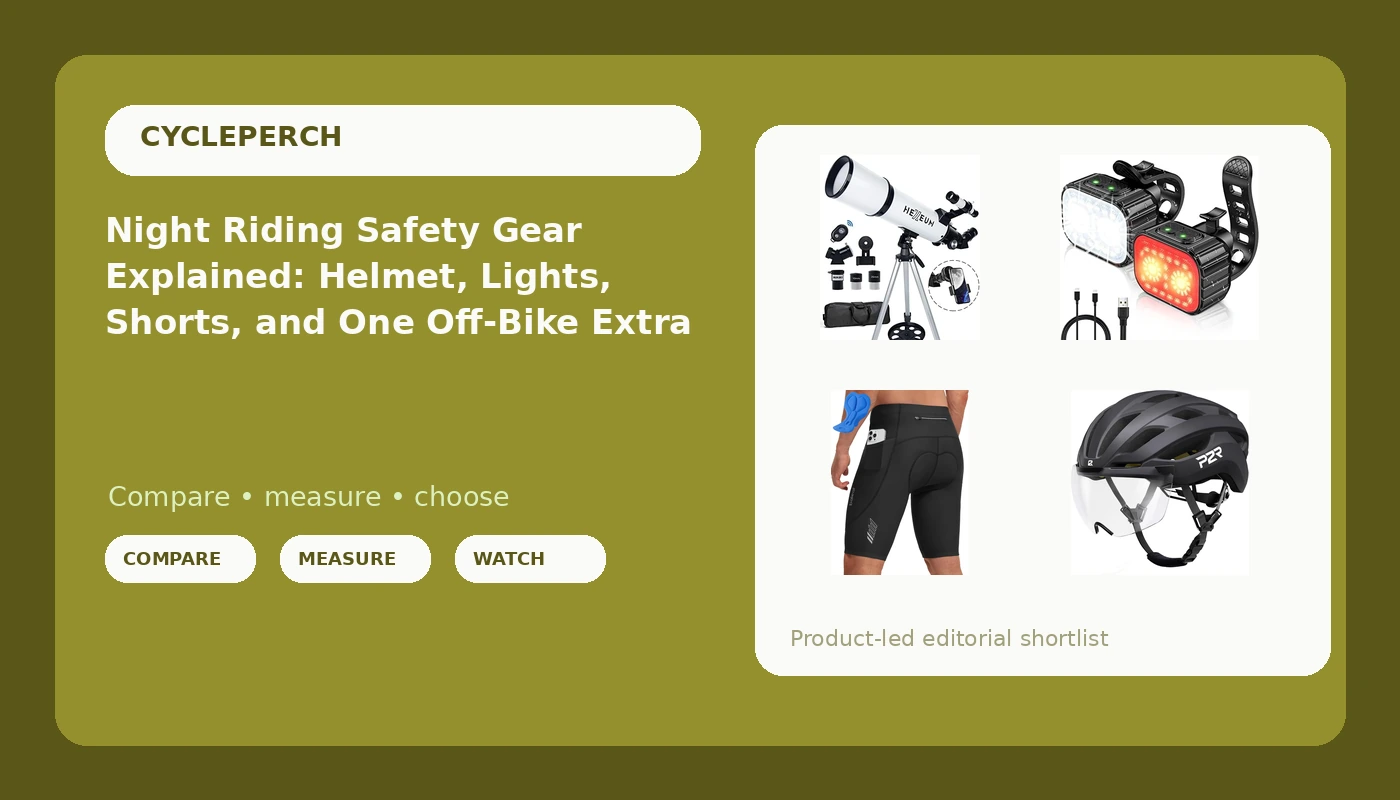
Riding after dark is not the same sport as riding at noon. The temperature drops, the potholes vanish into the pavement, and every driver's depth perception gets worse at exactly the moment yours needs to be perfect. Night riding safety gear is the answer to that problem, but the category is full of claims that are hard to check: lumen numbers printed on a box, "waterproof" with no rating behind it, padding described with numbers that do not correspond to anything you can measure with a ruler. This guide walks through what each piece of gear actually does, what the spec sheet can and cannot tell you, and how to decide which item earns a place on your bike first. Three of the four products here are cycling gear. The fourth is not, and I would rather say that out loud than pretend a telescope belongs on a handlebar.
Related: How to Fit a Bike Helmet So It Actually Stays Put →
Quick answer
For riding after dark, the order that matters is visibility, protection, then comfort. A helmet that fits properly and a light set you will actually remember to recharge do more for you at night than any upgrade further down the bike. Padded shorts start to matter as the miles get longer, and a padded underwear style is the cheapest way to find out whether padding helps you at all before you spend real money on bibs. The telescope in this list is not cycling equipment and should not be bought as safety gear; it is here for the readers who ride at dawn and want something to do with the rest of the evening.
Four options worth a look
| Model | Best fit | What stands out |
|---|---|---|
| P2R A20 MIPS Bike Helmet for Teens and Adults with Rear LED Light | Riders who want head protection and a rear light in one item | A MIPS liner plus an integrated rear LED |
| Cuvccn Bike Lights Super Bright, Rechargeable Bicycle Lights Set | Commuters and anyone riding mixed light conditions | A rechargeable front and rear pair with multiple modes |
| baleaf Men's 4D Padded Bike Shorts Cycling Bicycle Underwear | Riders who want padding without a full bib or short | 4D padding in an underwear style worn under other shorts |
| Koolpte Telescope for Adults, 80mm/600mm AZ Refractor for Beginners | Beginners who want a first telescope for the evening | 80mm aperture refractor with a 600mm focal length on an AZ mount |
Safety first: P2R A20 MIPS Bike Helmet for Teens and Adults with Rear LED Light
MIPS is a low-friction layer between the shell and your head, designed to allow a small amount of relative movement during certain angled impacts. It is one of several rotational-management systems on the market, and it is not a promise that you cannot be injured. What it does is add a design feature that most helmet makers now consider worth having, which is why you see it across price points instead of only at the top.
The rear LED is the more interesting detail for night riding. It sits high, roughly at driver eye level in traffic, which is a genuinely useful place for a light. It is also small, and a small light is a supplement to a proper taillight, not a replacement for one. Treat the helmet light as the thing that keeps you visible if your bar-mounted setup dies, not as the whole plan.
Be seen: Cuvccn Bike Lights Super Bright, Rechargeable Bicycle Lights Set
Buying the front and rear together solves a real problem: riders who buy one good light and one terrible one, then wonder why cars keep closing on them from behind. A set also means the two units use the same charging routine, which is the difference between a charged light and a dead one on the morning you leave early.
The words to be careful with are "super bright" and "long battery life." Those are marketing descriptions, not measurements. A light's useful output depends on the beam pattern as much as the number on the box, and runtime depends on which mode you use, how cold it is, and how old the cells are. When a listing describes a light as waterproof, look for an IP rating rather than the word alone, because "waterproof" without a number is a hope. None of that makes this set a bad buy. It makes it a set you should charge, test, and judge on your own route.
Comfort: baleaf Men's 4D Padded Bike Shorts Cycling Bicycle Underwear
Padded underwear is the lowest-risk way to find out whether padding changes your ride. You keep the shorts you already like, add a layer underneath, and the answer arrives within a few rides. It is also the practical choice for commuters who do not want to walk into an office in Lycra, and for mountain bikers who prefer baggies over bibs.
The "4D" in the name is a manufacturer's description of the padding construction, not a standard you can compare across brands. What matters is where the pad sits relative to your sit bones and whether it stays put when you stand and sit. A pad that shifts is worse than no pad at all, because moving fabric creates the friction it was supposed to prevent. Wash padded shorts after every ride, and skip fabric softener, which coats the material and shortens its life.
Off-bike extra: Koolpte Telescope for Adults, 80mm/600mm AZ Refractor for Beginners
This is the item that does not belong in a cycling article, so let me be direct about it. A telescope protects nothing, lights nothing, and cushions nothing. It will not make you safer on a Tuesday morning commute, and no amount of enthusiasm changes that. If you are here for night riding gear, skip this section and spend the money on a second taillight instead.
Where it does make sense is the overlap between the two hobbies. Riders who are out before sunrise and after sunset already spend a lot of time under a dark sky, and an 80mm refractor on a simple alt-azimuth mount is a reasonable first instrument for that kind of curiosity. Aperture and focal length are the two numbers worth understanding: aperture governs how much light you gather, and focal length helps determine magnification with a given eyepiece. Do not point any telescope at the sun without a proper solar filter, and do not ride with one. It is an evening object, not a bike accessory.
Prices and availability may change. Product images, names, and retailer links are matched to specific listings. This page does not state a current price, rating, stock status, or measured result for any product, and it should not be read as one.
What a lumen claim actually means
Lumens measure total light output, and a claimed number is usually the highest figure the light reaches in one mode, at one moment, with a fresh charge. That number says nothing about where the light goes. A 600-lumen light with a shaped beam that throws a wide, even pool on the road can be easier to see by and see with than a 1,500-lumen light that sprays half its output into the trees and oncoming eyes.
Beam pattern is the part you can evaluate without a lab. A good front light puts most of its light on the road ahead, with a cutoff that keeps it out of drivers' faces. A good rear light spreads sideways so it reads as a light from an angle rather than a dot from directly behind. Mode selection matters too: a steady beam is easier to track at distance, a flashing pattern is easier to notice in the periphery, and the honest answer for commuting is that you want both available.
Runtime is the other half of the equation. Cold weather reduces lithium battery capacity, so the light that runs for hours in July may run noticeably shorter in February. That is a property of the chemistry, not a defect. If the battery is not replaceable, the light has an expiration date built in, and that is worth knowing before you buy rather than after.
Helmet fit, MIPS, and integrated lights
A helmet only works when it fits, and fit is measurable. Put the helmet on without the straps, tilt your head down, and see whether it slides. If it does, tighten the retention dial. The front edge should sit level, roughly a couple of fingers above your eyebrows, not tipped back like a sun visor. The side straps should meet in a V just below your ear, and the chin strap should be snug enough that you can fit about two fingers under it. Then check that the rear LED is actually switched on, because an unlit light on a helmet is just weight.
MIPS is one approach to managing rotational forces during angled impacts, and it is common enough that it no longer signals a premium price. What no helmet can promise is that you will walk away from a crash. What a well-fitted helmet does is stay in place and absorb energy in the way it was designed to, which is why fit gets checked before brand loyalty does.
Five steps to work through before your first dark ride:
- Set the helmet retention and strap tension with the helmet on, not in your hand.
- Charge the light set fully, then run it through every mode so you know the sequence without looking down.
- Aim the front light at the road about 10 to 15 feet ahead, not at eye level for oncoming traffic.
- Check that your rear light is visible from the side, not only from directly behind.
- Ride your normal route once in daylight to spot the hazards that disappear after sunset.
Practical guidance for the first night ride
- Charge everything the night before, and charge the backup light too, not just the one you plan to use.
- Carry a second rear light, because the rear is the position drivers approach from and the one you cannot see failing.
- Test the waterproofing claim on your terms by checking for an IP rating before you trust a light in rain.
- Keep mounts clean and check them for cracks, since a stripped bracket is how good lights end up on the shoulder.
- Wear something reflective above the waist, where headlights actually reach, and remember that pedals and shoes move.
Which option should you choose?
Choose the P2R A20 MIPS Bike Helmet when you need a helmet anyway and want a rear light built into the item you never leave home without. Choose the Cuvccn Bike Lights Set when your current lights are dim, mismatched, or running on disposable batteries you keep forgetting to buy. Choose the baleaf 4D Padded Bike Shorts when long rides leave you sore and you want to test padding without committing to full cycling kit. Choose the Koolpte Telescope only if you want a beginner telescope for its own sake, because it does nothing for you on the bike.
One caveat applies to all of it. This page describes what each product is and what its listing claims, not what it measured in a test. Output, runtime, waterproofing, and comfort all depend on your route, your climate, and how you use the gear, so judge the light set on your own commute and the shorts on your own saddle before you decide they are keepers.
The bottom line
Night riding safety gear comes down to three jobs: be seen, be protected, and stay comfortable enough to keep riding. A helmet with a MIPS liner and a rear LED covers the first two at once, a rechargeable front and rear light set covers the rest of your visibility, and padded shorts handle the part of the ride that nobody talks about until mile forty. Buy the safety items first, because a comfort upgrade never got anyone home from a dark road. The telescope is a fine evening hobby and a terrible bike accessory, and it belongs in your cart only if you know which of those two things you are shopping for.