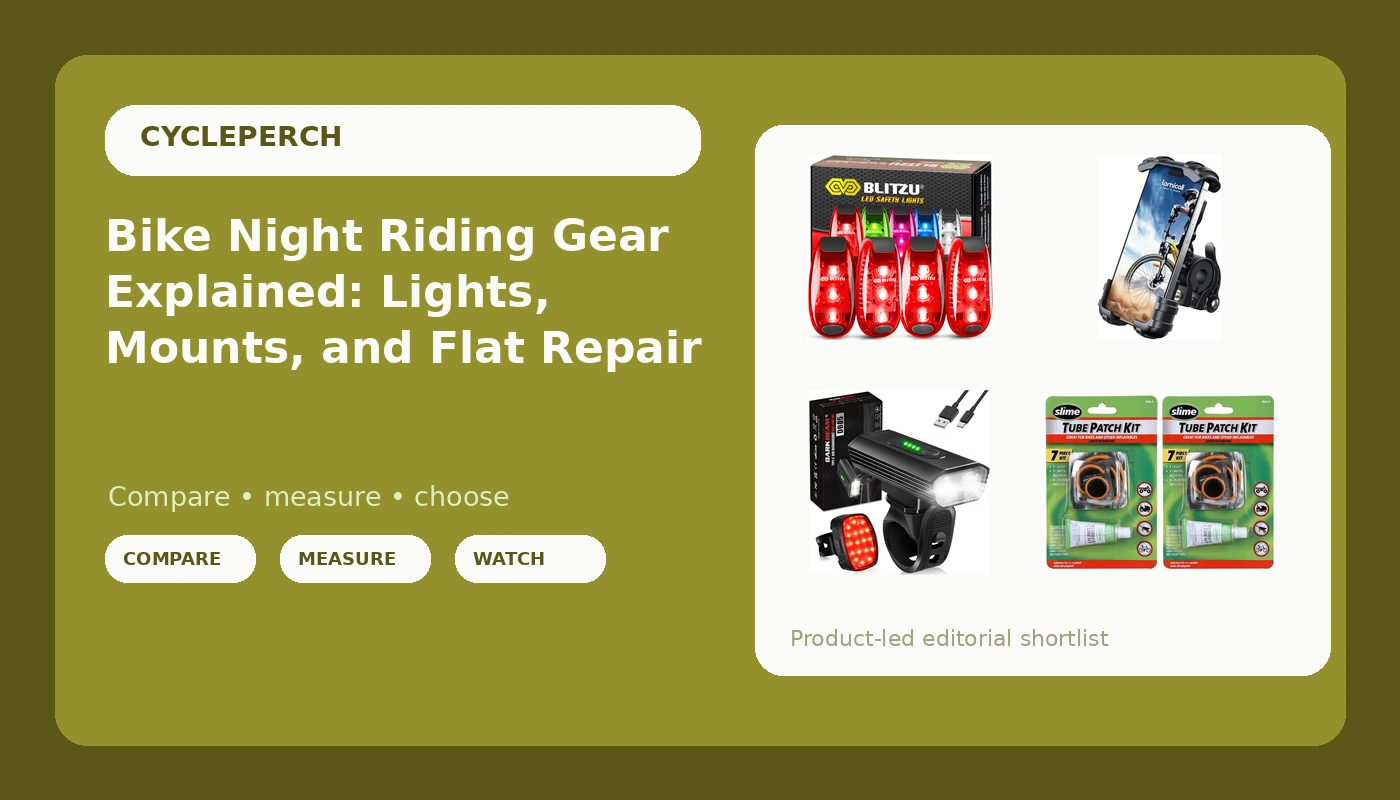
Night riding is where gear decisions stop being preferences and start being arithmetic. The sun sets earlier than your commute ends for a good chunk of the year, and the rider who planned their bike night riding gear in September is the one still on the bike in November. This is a plain look at four items that cover the ways an evening ride actually goes wrong: not seeing the road, not knowing the next turn, not being seen by a driver who is looking somewhere else, and standing on the shoulder with a flat tube and no plan. Every one of them installs without a shop visit, and every one of them fails in a way you can predict if you know what to look for before you buy.
Related: How to Read Bike Light Lumen Claims →
Quick answer
The practical kit for riding after dark is a rechargeable front light you can top up from the same USB-C cable as your phone, a phone mount that holds the phone still at speed, a set of clip-on safety lights you can spread across yourself and the bike, and a patch kit so a puncture costs ten minutes instead of a ride. The DARKBEAM Bike Headlight handles seeing, the Lamicall Bike Phone Holder handles navigating, the LED Safety Lights 4 Pack handles being seen, and the Slime 1022-A Tube Rubber Patch Kit handles getting home. None of them is a complete solution on its own, and that is the honest framing.
4 useful options
| Model | Best fit | What stands out |
|---|---|---|
| DARKBEAM Bike Headlight Rechargeable USB-C, Bicycle Lights 4000LM | Riders who want a self-contained handlebar light | Rechargeable through USB-C, with a manufacturer output claim of 4000LM |
| Lamicall Bike Phone Holder Motorcycle Mount - One-Hand Operation, Lockable | Riders who navigate from a phone screen | One-hand operation with a lockable clamp |
| LED Safety Lights 4 Pack, Clip On High Visibility Strobe Light for Walk Run | Riders, runners, and walkers who need to be seen | Four separate clip-on strobe units in one pack |
| Slime 1022-A Tube Rubber Patch Kit, for Bikes and Other Inflatables, Contains, 5 Patches, Scuffer and Glue (Pack of 2) | Anyone running tubes | Five patches, a scuffer, and glue, sold as a two-pack |
Front light: DARKBEAM Bike Headlight Rechargeable USB-C, Bicycle Lights 4000LM
A printed lumen number is a ceiling, not a promise. The gap between the box and a real measurement is where most light disappointment lives, and it is the reason I care more about beam pattern than peak output. A light that throws a narrow hotspot down the road tells you less than a light that spreads usable light across the width of a bike lane, because the thing you actually need to see is the pothole at the edge, not the reflector at the center. Beam shape is not printed on any box, which is why a front light deserves a test ride on your own commute before you trust it on a fast descent.
The USB-C port is the quiet win here. One cable for the phone, the light, and the computer means fewer things to forget, and fewer things to forget means fewer nights riding home with a dying beam. The other thing worth thinking about is battery service. If a battery is sealed into the housing, the light has an expiration date, and the schedule belongs to the manufacturer rather than to you. That is a legitimate trade against weight and water resistance, but it should be a decision you make on purpose rather than a surprise in year three.
Phone mount: Lamicall Bike Phone Holder Motorcycle Mount - One-Hand Operation, Lockable
A phone mount is a mechanical device, and mechanical devices get judged on one question: does the phone stay where you put it when the road gets bad? The lockable clamp and one-hand operation described in this listing are the two features that matter most, because the failure mode of a weak mount is not subtle. It is a phone on the pavement at speed, which is a screen replacement, a lost ride file, and possibly a lost ride. One-hand operation sounds like a convenience until you try to load a phone into a tight clamp while stopped at a light with a car behind you.
Two setup notes that apply to every mount of this style. First, position it so the phone does not block your headlight beam or your view of the front wheel line; a bright screen an inch above a light housing throws glare back at your eyes. Second, remember that cold weather is hard on phone batteries, and a phone that lives on the bars in January will drain faster than the same phone in a jersey pocket. If navigation is essential on a long winter ride, plan the charge the way you plan the layers.
Secondary visibility: LED Safety Lights 4 Pack, Clip On High Visibility Strobe Light for Walk Run
Front and rear lights solve the problem of being seen from the front and from behind. They do not solve the problem of being seen from the side, which is the angle that matters most at a driveway, a parking lot exit, and every intersection where a driver is looking left and right rather than straight ahead. A clip-on strobe on a bag strap, a belt, or a jacket hem adds a moving point of light at driver eye level, and movement is what catches peripheral vision.
The four-pack format is the part I like, because it removes the excuse. One unit on the saddle bag, one on a backpack strap, one on the jacket, and one spare that lives in the bag or on a kid's jacket. Clip-on lights also cross over cleanly to the rest of your household: a strobe on a walking jacket or a running belt does the same job it does on a bike. If you ride with a family member or a partner who does not own dedicated cycling lights, this is the cheapest way to make both of you visible.
Flat repair: Slime 1022-A Tube Rubber Patch Kit, for Bikes and Other Inflatables, Contains, 5 Patches, Scuffer and Glue (Pack of 2)
A patch kit is not a replacement for a spare tube. It is the thing that saves you when the spare tube is already in use, when the puncture is small and clean, or when you are five miles from home and would rather not spend the next twenty minutes wrestling a tire in the dark. The scuffer is the step people skip and the reason patches fail: rubber glue needs a roughened, clean surface to bond to, and a patch pressed onto a smooth tube will lift at the first sign of heat or flex. Scuff, apply glue, wait for it to get tacky, then press the patch and hold it.
The two-kit format is genuinely useful here. One kit lives in the saddle bag with the levers and the spare tube, and the second lives in the garage or the car, which is where you want it when the inflatable that needs patching is a wheelbarrow, a stroller, or a pool toy rather than a bike. That is the "other inflatables" part of the listing doing real work.
Prices and availability may change. Product images, names, and retailer links are matched to verified listings. No current price, rating, stock status, or measured result is stated here without current evidence.
What a lumen number does and does not tell you
Lumen figures on bike light packaging describe total light output under test conditions that are rarely the conditions you ride in. Two lights with the same printed number can look completely different on the road, because output is only half the story and the other half is how that output is shaped and aimed. A tight hotspot at high output can be worse than a broader, lower-output beam on a bike path, and a poorly aimed light is worse than either one, because it puts light into oncoming eyes instead of onto the road.
The second number to be skeptical about is runtime. Claimed hours are usually measured at the lowest steady mode, not the mode you will actually ride in, and cold weather pulls battery capacity down on every chemistry. If a light claims a long runtime, the honest question is what mode that number belongs to and what temperature it was measured at. If the manufacturer does not say, assume the best case.
The third question is serviceability. Mounts strip, brackets crack, and batteries age. A light whose mount is a proprietary piece of plastic with no spare part available has a shorter working life than its electronics suggest, because the first thing to fail is the cheapest thing on the bike. Before you buy, look for a replacement mount and a replacement battery. If neither exists, you are buying a disposable product with a light on top.
Five checks before you buy night gear
- Decide what job the item does. Seeing the road, being seen from the side, navigating, and repairing a flat are four different jobs, and one product rarely does two of them well.
- Confirm the charging standard. USB-C on both the light and your phone means one cable and one wall plug, which is the difference between a charged light and a dead one on a Tuesday.
- Look for the spare parts. Mounts, brackets, and batteries are what fail first, so check that replacements exist before the original breaks.
- Match the mount to your bars. Handlebar diameter, cable routing, and bag clearance all decide whether a mount works on your bike rather than on the photo.
- Price the whole job. A cheap item that needs an hour of fitting and a trip to the shop is not cheap, and shop-rate hours are part of the cost.
Setting up the four pieces
- Aim the front light down and slightly to the right so the beam lands on the road, not in the eyes of drivers and riders coming the other way.
- Put the phone mount where the screen does not sit directly above the headlight, because glare off a bright screen is worse than no screen at all.
- Clip the safety strobes at hip and chest height on your body, not just on the bike, so they move with you and catch peripheral vision.
- Build one small saddle bag with the patch kit, tire levers, and a spare tube, and check it before every long ride rather than the night you need it.
- Charge everything on the same schedule, ideally the evening before a ride, so you never leave with a light at half capacity and a phone at twenty percent.
Which option should you choose?
Choose the DARKBEAM Bike Headlight Rechargeable USB-C, Bicycle Lights 4000LM when you need a self-contained front light and you want to charge it from the same cable as your phone. Choose the Lamicall Bike Phone Holder Motorcycle Mount - One-Hand Operation, Lockable when you navigate from a phone and want a clamp you can load with one hand. Choose the LED Safety Lights 4 Pack, Clip On High Visibility Strobe Light for Walk Run when side visibility is the gap in your current setup, or when you ride with people who do not own dedicated lights. Choose the Slime 1022-A Tube Rubber Patch Kit, for Bikes and Other Inflatables, Contains, 5 Patches, Scuffer and Glue (Pack of 2) when you run tubes and want a repair option that survives a second puncture.
The caveat that applies to all four: nothing here substitutes for riding as if you are invisible. Lights, mounts, and patch kits reduce risk and inconvenience, and they do not eliminate either one. The specification claims on the packaging are the manufacturer's, not measurements, and the only way to know how a light, a clamp, or a patch behaves is to use it on your own roads in your own weather.
The bottom line
Night riding gear is a system, and the system is only as strong as its weakest piece. A bright front light with no side visibility leaves you unseen at driveways. A phone mount that drops the phone ends the navigation. A patch kit with no scuffer in the bag is a plastic box. Buy the four jobs separately, install them properly, torque the mounts to spec rather than hand tight, and check the whole setup before the first dark ride of the season instead of the night it matters.