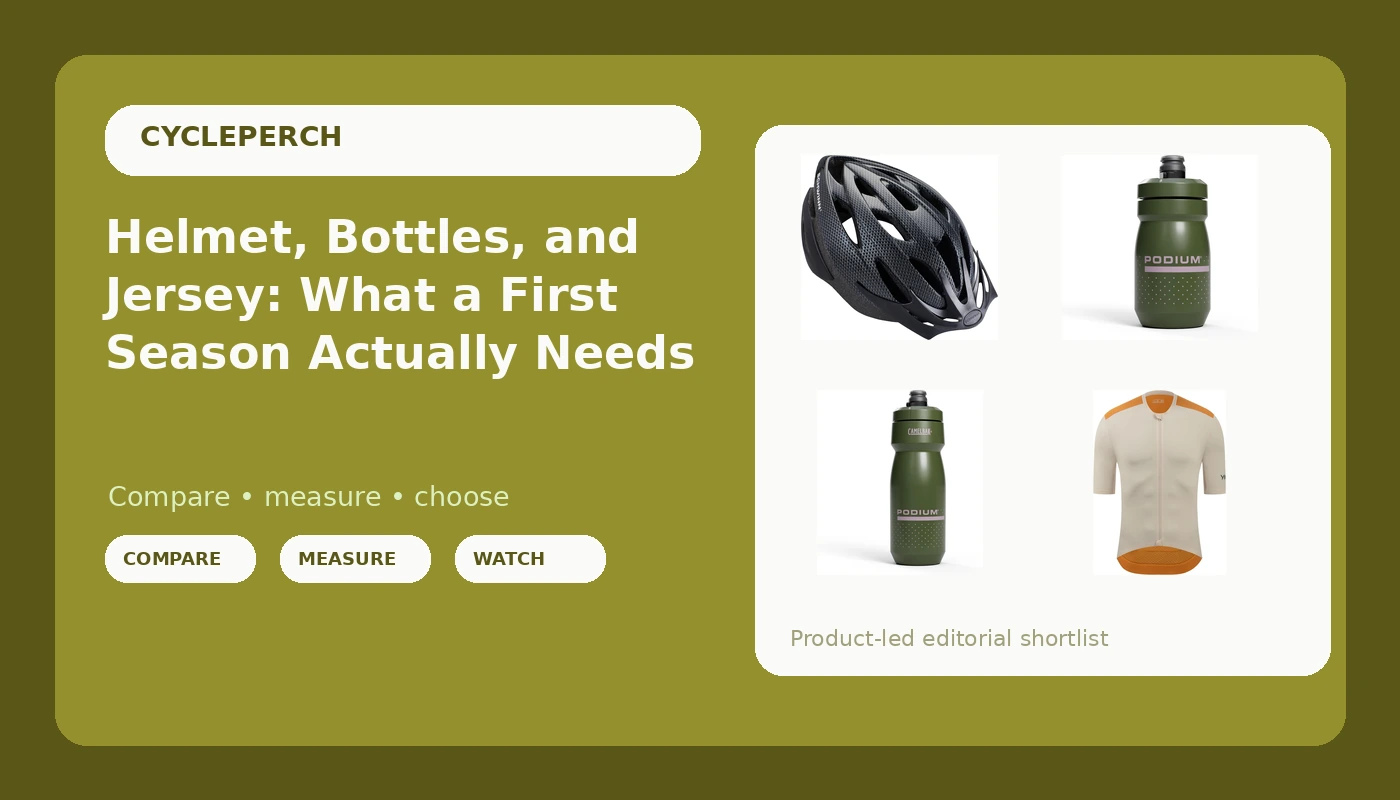
Most riders building a first season of gear buy it backwards. They start with the thing they can picture themselves in, a jersey with a race cut and a logo, and they finish with the boring parts: a helmet that fits the head they actually have, bottles that fit the cages they actually own, and enough pocket space to carry the ride home. A cycling helmet and bottle setup is not glamorous, and it is the part of the kit that decides whether the first hundred kilometers feel like a hobby or a chore. This is not a pile of spec sheets. It is an explanation of what each of these four pieces does, who it fits, and where the money should go first.
Related: How to Fit a Bike Helmet Without Guessing →
Quick answer
Buy the helmet first, because it is the one piece that has to match a measurement rather than a preference, and everything else can wait a paycheck. The Schwinn Thrasher Helmet for Adults covers a 58-62 cm head range with a dial fit system and straps you adjust yourself. After that, pick bottles by ride length: the CamelBak Podium 15 oz for short efforts and the 24 oz for long ones, both in Deep Fern, both fitting the same cage. Then add the YKYWBIKE Cycling Jersey for the pockets, not the print. Fit and capacity are the decisions here. Color and branding are the easy part.
Four useful options
| Model | Best fit | What stands out |
|---|---|---|
| Schwinn Thrasher Helmet for Adults, Size 58-62 cm for Riders Ages 14+, Microshell, Adjustable Dial & Straps, Interior Padding, Air Vents, Visor, Adult Bike Helmet | Riders who need a measured fit range and adjustable straps | Stated 58-62 cm sizing, dial adjustment, microshell shell, vents and visor |
| CamelBak Podium Water Bottle 15oz, Deep Fern | Short rides, small frames, tight cages | 15 oz capacity in a compact bottle |
| CamelBak Podium Water Bottle 24oz, Deep Fern | Long rides and hot afternoons | 24 oz capacity, same Podium family and color |
| YKYWBIKE Cycling Jersey Men with Pockets Bike Jersey Short Sleeve Biking Shirts for Men Cycling Breathable MTB Biker Shirts | Riders who want to carry food and a phone without a pack | Short sleeve men's cut with pockets, described as breathable |
Head protection: Schwinn Thrasher Helmet for Adults, Size 58-62 cm for Riders Ages 14+, Microshell, Adjustable Dial & Straps, Interior Padding, Air Vents, Visor, Adult Bike Helmet
A helmet is the one purchase in this group where the spec sheet is a starting point, not an answer. The size range tells you whether your head is in the conversation; the dial and the straps tell you whether you can get the shell to sit level and stay there. Wrap a soft tape around your head just above the ears, roughly where a cap band sits, and write the number down. If you land at 57 cm, this helmet is not for you, and no amount of dialing will fix a shell that is the wrong size. If you land at 59 or 60, you are in the middle of the stated range, which is usually the friendliest place to be.
The vents and the visor are comfort features, not performance claims. Vents move air when you are moving; a visor keeps low sun and light rain off your face. Interior padding is what contacts your head, and padding is the first thing to wear out on any helmet, so treat it as a wear item and keep the shell clean. Nothing here replaces a proper fit check, and a helmet that lives loose on your head is not doing the job you paid for.
Short rides: CamelBak Podium Water Bottle 15oz, Deep Fern
Fifteen ounces is roughly one good hour of hard riding in mild weather, and that is the honest way to think about it. If your rides are 45 minutes on a greenway or a commute that ends at a desk with a water cooler, a small bottle is the right tool. It weighs less, it clears a tight frame better than a tall bottle, and it does not slosh around when it is half empty. The trade-off is obvious: on a two hour ride you will either refill or go thirsty, and on a hot day you will do both.
Small bottles also have a second life as your second cage bottle on long days, which is why buying two of the same family makes sense. If you run a 24 oz in the down tube and a 15 oz on the seat tube, you have 39 ounces aboard and you never have to think about which bottle is which. Deep Fern is a muted green that will not clash with most frame colors, and matching the pair is a small thing that makes the bike look intentional rather than assembled.
Long rides: CamelBak Podium Water Bottle 24oz, Deep Fern
Twenty-four ounces buys you another hour, and it buys you something less obvious too: fewer stops. The riders who complain that they cannot finish a long ride usually are not undertrained, they are underhydrated and overstopped. A bigger bottle is the cheapest fix for that, cheaper than a hydration pack and a lot cheaper than a new bike.
The one thing to check before you buy the big one is cage clearance. A tall bottle can foul a small frame, a frame bag, or a second bottle on the seat tube, and that is a fit problem no capacity number solves. Fill a bottle at home, put it in the cage, and turn the bars lock to lock. If it rubs, drop to the 15 oz in that position and keep the 24 oz where it fits. Two sizes of the same bottle is not indecision, it is a system.
Pocket space: YKYWBIKE Cycling Jersey Men with Pockets Bike Jersey Short Sleeve Biking Shirts for Men Cycling Breathable MTB Biker Shirts
The reason cyclists wear jerseys has almost nothing to do with looking like cyclists. It is the pockets. Three pockets across the lower back put a banana, a phone, a multitool, and a folded vest where you can reach them without stopping and without a backpack heating up your spine. If you have been riding in a t-shirt and stuffing gels in your shorts, a jersey is the upgrade that changes how a long ride feels, and it costs less than almost any component on the bike.
Fit is the variable to watch. A jersey should be close enough that loaded pockets do not swing, and loose enough that you can breathe hard in it. Sizing charts vary by maker, so measure your chest and compare it to the chart rather than trusting the size you wear in street clothes. Breathability is a fabric description here, not a number, so treat it as a comfort claim and judge it on your first warm ride.
Prices and availability may change. Product images, names, and retailer links must be matched by verified ASIN. Do not state a current price, rating, stock status, or measured result without current evidence.
How to size gear you cannot try on
Buying online means you are the fitting room. For a helmet, that starts with a circumference measurement taken with a soft tape, not a guess from hat size. Hat sizes run small compared to helmet sizes, and a "large" baseball cap has nothing to do with a 58-62 cm shell. Measure, write the number down, and check it against the stated range before you order.
For bottles, the measurement is physical: cage height, frame clearance, and how much liquid your typical ride actually consumes. For jerseys, it is chest circumference plus the question of how you want the fabric to sit when the pockets are full. None of these require a shop visit, and all of them require five minutes and a tape measure. The riders who get gear right the first time are not luckier, they just measured before they clicked buy.
There is also a sequencing argument. A helmet that does not fit is useless at any price, a bottle that does not fit the cage is a paperweight, and a jersey with pockets that swing is worse than a t-shirt. Buy in the order that removes the most risk: fit first, capacity second, comfort third. Upgrades to the bike itself can wait until the kit stops fighting you.
Bottle capacity, cage fit, and pocket math
The math is simple enough to do on the back of a receipt. Most riders drink roughly one bottle per hour in moderate weather and more in heat, so a 15 oz bottle is a short-ride bottle and a 24 oz bottle is a long-ride bottle. Two 24 oz bottles give you close to two hours of self-supported riding before you need a refill point, which is the number that should drive your route planning.
- Measure your head circumference in centimeters with a soft tape and compare it to the stated 58-62 cm range.
- Count how long your typical ride runs, then match bottle capacity to hours rather than to how the bottle looks.
- Test cage clearance at home with a full bottle before you commit to the tall size.
- Measure your chest and compare it to the jersey maker's chart instead of your street-clothes size.
- Replace worn helmet padding and tired bottles on a schedule, because both are wear items, not lifetime purchases.
What to buy first, and what to skip
- Buy the helmet first. It is the only item here whose fit cannot be adjusted around a wrong starting size.
- Buy one bottle before you buy two. Confirm the cage holds it through a pothole, then buy the matching pair.
- Skip the hydration pack until you have tried two bottles. Most riders never need the pack.
- Skip a second jersey before you know the first one fits with loaded pockets.
- Treat padding, bottle valves, and jersey elastic as wear items and budget for replacing them.
Which option should you choose?
Choose the Schwinn Thrasher Helmet for Adults, Size 58-62 cm for Riders Ages 14+, Microshell, Adjustable Dial & Straps, Interior Padding, Air Vents, Visor, Adult Bike Helmet when your measured head circumference falls inside the stated 58-62 cm range and you want a dial fit system you can tune yourself. Choose the CamelBak Podium Water Bottle 15oz, Deep Fern when your rides are short, your frame is small, or you want a second bottle that clears a tight seat tube. Choose the CamelBak Podium Water Bottle 24oz, Deep Fern when your rides run past an hour and refill stops are inconvenient. Choose the YKYWBIKE Cycling Jersey Men with Pockets Bike Jersey Short Sleeve Biking Shirts for Men Cycling Breathable MTB Biker Shirts when you want to carry food and a phone on your back instead of in a pack.
One caveat applies to all four: nothing here is a substitute for checking the numbers yourself. Sizing ranges, capacities, and fit charts are published by the maker, and the only measurement that decides whether a product works for you is the one you take at home. If your head measures outside the stated range, no review can talk you into a helmet, and if your cage will not hold a tall bottle, capacity is irrelevant.
The bottom line
A first season of gear does not need to be expensive, it needs to be ordered correctly. Helmet first, sized to your measured head. Bottles second, sized to your ride length and your cage. Jersey third, chosen for the pockets and checked against a chest measurement. Get those three decisions right and the rest of the kit becomes optional rather than urgent, which is the whole point of buying once instead of twice.