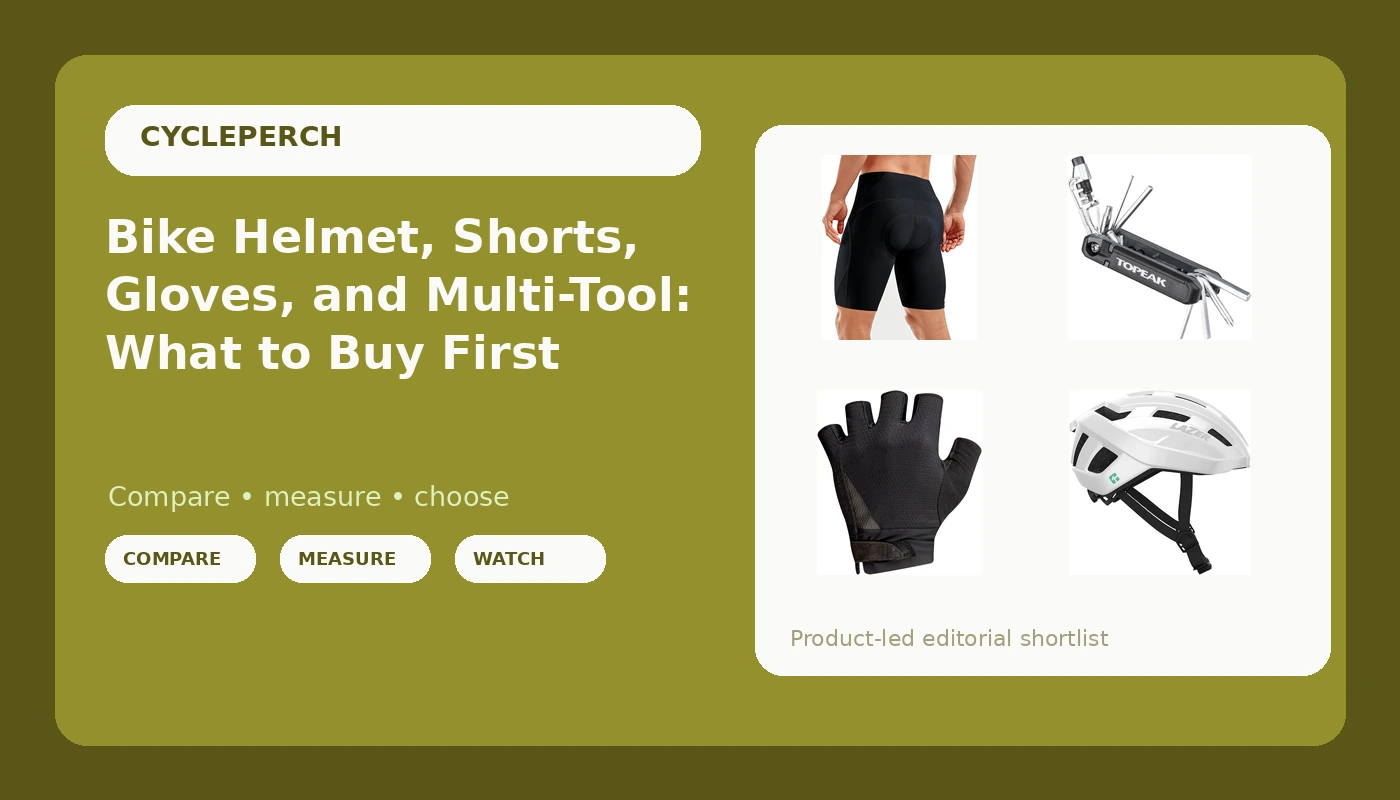
Cycling gear essentials get sold in two directions at once. One is the race-day upgrade that promises free speed. The other is the twelve-dollar impulse buy that ends up in a drawer. Neither helps the rider who wants to get out three times a week without numb hands, a sore backside, or a long walk home. The four items below sit on the contact points and failure points that show up first: your head, your hands, your seat, and the bolts that hold the bike together. This is an explainer, not a leaderboard. Each product gets a role, the trade-off that comes with it, and the question worth answering before it goes in a cart.
Related: How to Build a Flat Kit That Actually Works →
Quick answer
For most riders building a first real kit, the order that pays off fastest is helmet, padded shorts, gloves, then a multi-tool that lives on the bike. The helmet is the one item where a defect is not an inconvenience, so fit and certification come before color and weight. Shorts and gloves address the contact points that end rides early, and a multi-tool covers the small adjustments that would otherwise end a ride at the trailhead.
Four useful options
| Model | Best fit | What stands out |
|---|---|---|
| LAZER Tempo KinetiCore Bike Helmet | Riders who want rotational-impact construction in an everyday shell | KinetiCore impact protection design in a lightweight adult helmet |
| Sportneer Padded Bike Shorts for Men | New riders who want padding without a race-fit commitment | 4D padding and UPF 50+ fabric in a men's cut |
| PEARL IZUMI Elite Gel Bike Gloves | Riders dealing with hand pressure or grip fatigue | Gel padding at the palm with a men's cycling fit |
| Topeak Hexus X Multi-Tool | Anyone who wants one tool for the bike and the trailside | 21 functions, including a chain tool, tire levers, and a Presta core tool |
Protection first: LAZER Tempo KinetiCore Bike Helmet
A helmet is the one purchase on this page where the failure mode is not discomfort. That changes how you shop for it. Fit comes first: the shell should sit level, roughly a finger's width above the eyebrows, with the retention dial snug enough that the helmet does not shift when you push it side to side with your palm. Every brand shapes its shells differently, so the same size letter means different things across manufacturers. Buy for the shape that matches your head, not the number you wore in a previous helmet.
The second question is certification. In the United States, a bike helmet sold for cycling should carry a CPSC certification statement, and that is the baseline, not a premium feature. Rotational-impact designs such as KinetiCore sit on top of that baseline, and they are worth understanding rather than assuming. The third question is age. Foam and straps degrade, and a helmet that has taken a real impact is done, even if the shell looks fine from the outside. A used helmet is a hand-me-down with an unknown history, which is why the shop answer to "should I buy this one secondhand" is usually no.
Comfort layer: Sportneer Padded Bike Shorts for Men
Padded shorts do one job: they put a layer of foam and fabric between your sit bones and a saddle that was never designed to be sat on in street clothes. The chamois matters less than the fit of the shorts around it. If the pad shifts when you pedal, it will chafe at kilometer twenty, and the padding becomes the problem instead of the fix.
Two habits make padded shorts work better. First, wear them against skin rather than over underwear, because seams and cotton folds under a chamois are what cause saddle sores. Second, wash them after every ride. A chamois that sits damp in a gym bag is a bacterial culture, and the fabric will not forgive you. A pair like this is a reasonable first chamois because the cost of entry is low and the padding is generous. What it is not is a race short, so expect a looser, more recreational fit than a skin-tight bib.
Contact point: PEARL IZUMI Elite Gel Bike Gloves
Hand numbness on a road bike is usually a position problem wearing a glove problem's clothes. If your wrists are bent back and your arms are locked, no amount of gel will fix it. Fix the reach and the saddle-to-bar drop first, then let padding handle the rest. That said, gel at the ulnar nerve and the heel of the palm genuinely extends how long you can stay on the hoods, and gloves add grip in the rain and a layer of skin between your palms and the pavement in a fall.
Sizing is where most riders get gloves wrong. Gloves should be snug with no fabric bunching between your fingers, and they should not stretch out after a few rides to the point where they twist. Wash them by hand or on a gentle cycle and let them air dry, because a hot dryer turns gel padding into a lumpy mess and shrinks the synthetic panels. Half-finger gloves are a warm-weather item, so if you ride through winter, plan on a second pair for the cold months rather than expecting one pair to do both jobs.
On-bike repair: Topeak Hexus X Multi-Tool
Multi-tools are where cheap kits embarrass themselves. The chain tool is the usual culprit: a soft pin or a flexy body bends the first time you actually push a chain pin, which is exactly the moment you needed the tool to work. Chrome vanadium bits hold up better than mystery steel, and a chain tool that is properly machined is the difference between fixing a broken chain and calling for a ride.
The rest of the tool is about coverage. Hex keys in the sizes your bike actually uses, a Torx bit for disc brake bolts, a screwdriver, and tire levers that will not snap on a tight bead cover most roadside work. The Presta core tool is a small addition that matters more than it looks, because a valve core that is loose or clogged will have you chasing a slow leak that is not a puncture at all. One caution that applies to every multi-tool: the leverage is short, so use them to get home, not to finalize torque. Re-torque properly at the bench with a real torque wrench when you get back.
Prices and availability may change. Product images, names, and retailer links are matched to verified listings. No current price, rating, stock status, or measured result is stated here without current evidence.
What each piece of cycling gear actually does
It helps to sort cycling purchases by the problem they solve rather than the category they belong to. Protection gear limits the consequences of a crash. Contact point gear manages the three places your body touches the bike: hands, seat, and feet. Repair gear keeps a mechanical problem from turning into a walk. Everything else, and that includes most of what gets marketed hardest, is a performance or preference upgrade.
The helmet is protection, and it is the only item on this list with a certification standard behind it. Padded shorts and gloves are contact point gear, and their job is to make long rides tolerable rather than fast. The multi-tool is repair gear, and its value shows up on the worst day of the season, which is a hard thing to shop for because you cannot feel it in the store.
There is also a maintenance argument that runs underneath all of it. A drivetrain with a worn chain wears out cassettes and chainrings, and a chain checker is a cheaper purchase than a new drivetrain. A helmet that has been dropped hard on pavement is a replacement, not a spare. Shorts that have lost their padding shape are done, no matter how good the fabric still looks. Gear has a service life, and buying with that in mind is how you avoid buying the same thing twice.
How to decide what to buy first
- Start with the helmet. Confirm the size range for your head circumference, check that the model carries a CPSC certification for cycling, and make sure the retention system adjusts small enough to sit snug without a hat underneath.
- Add padded shorts next if your rides regularly pass the forty-five minute mark. Measure your waist and hips against the brand's chart rather than guessing, because a chamois that migrates is worse than no chamois.
- Buy gloves when you notice pressure or numbness in your palms. Size them snug, and accept that half-finger gloves are a three-season item at best.
- Add a multi-tool once you are riding farther than you want to walk back. Check that the hex sizes match your bike's bolts, and confirm the chain tool is rated for your chain speed.
- Fill in the gaps last. Tubes, a pump or CO2, tire levers you trust, and a saddle bag to carry it all matter more than any upgrade to the four items above.
Practical guidance before you order
- Measure before you buy. Head circumference for the helmet, waist and hip for shorts, palm width for gloves.
- Read the size chart on the listing, not the size you wear in street clothes, because cycling sizing runs small and inconsistent.
- Check the return policy. Helmets and chamois are the two categories where a fit mistake is most likely and most expensive.
- Plan for consumables. Shorts and gloves wear out faster than helmets, so budget for replacing them every season or two of regular riding.
- Re-torque anything you adjust on the road with a proper torque wrench at home, and never trust a multi-tool for final spec on carbon parts.
- Wash the soft goods after every ride. Pads, gloves, and straps are the parts of a kit that fail earliest when they are ignored.
Which option should you choose?
Choose the LAZER Tempo KinetiCore Bike Helmet when you are replacing a helmet or buying your first one and want rotational-impact construction in an everyday shell. Choose the Sportneer Padded Bike Shorts for Men when your rides have grown long enough that a plain short is no longer comfortable and you want padding without a race-fit price. Choose the PEARL IZUMI Elite Gel Bike Gloves when hand pressure or grip is the thing limiting your time on the bars. Choose the Topeak Hexus X Multi-Tool when you are riding far enough from home that a loose bolt or a broken chain should not end the day.
One caveat applies to all four. Fit and condition decide more than the spec sheet does. A helmet that does not match your head shape, shorts whose pad sits in the wrong place, or gloves that bunch at the fingers will underperform a cheaper item that fits. This article describes the products and the roles they fill; it does not report a measured outcome or a long-term wear test, and you should treat any claim about comfort or durability as something to verify against your own use.
The bottom line
Build the kit in order of consequence. The helmet first, because it is the one item where the downside is not inconvenience. Then padded shorts and gel gloves, which quietly decide how long you stay on the bike. Then the multi-tool, which earns its place on the one ride where something works loose twenty miles from the car. Everything after that is an upgrade, and upgrades are easier to justify once the essentials are actually in your bag.