Most riders buy gear in the wrong order. They replace what looks tired instead of what is actually failing, and they end up paying for the same category twice: once at the register, and once when the cheap version quits at kilometer 300. These cycling gear essentials cover four different jobs on one bike, and none of them overlaps with the others. One records the ride. One covers the largest area of skin contact. One protects the hands that hold the bars. One gives you a place to work. Figure out which of those four jobs you are currently doing badly, and the buying decision gets a lot shorter.
Related: How to Set Up a Home Repair Bay in a Small Space →
Quick answer
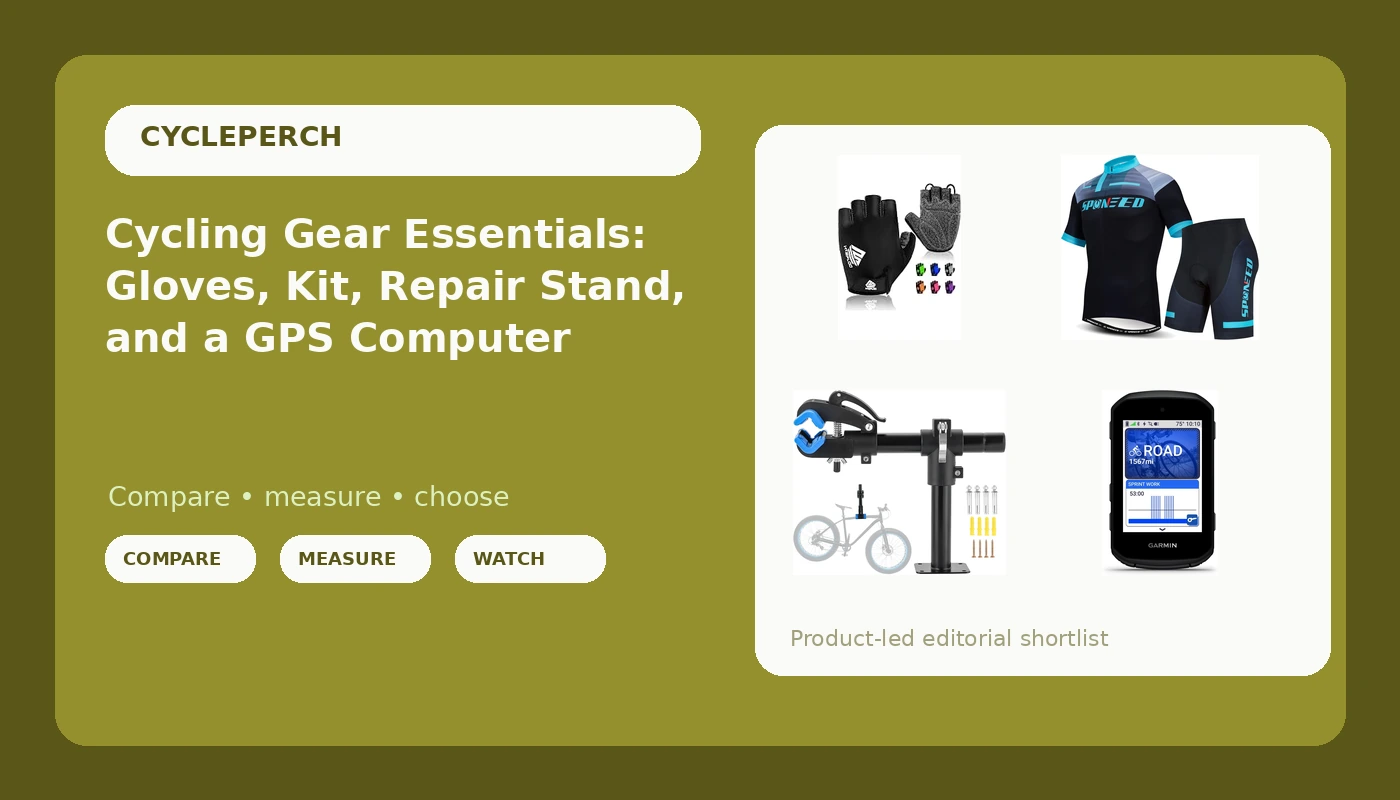
There is no single winner here, because the four items do four unrelated jobs. A compact GPS cycling computer records distance, speed, and route. A matched jersey and padded shorts suit handles the bulk of what touches the saddle and the bars. Half-finger gloves with a padded, anti-slip palm address the two contact points most riders ignore until their hands go numb. A wall-mount repair stand converts dead wall space into a working height bike holder. Buy the one whose job you are currently improvising.
Four useful options
| Model | Best fit | What stands out |
|---|---|---|
| Garmin Edge 850, Compact GPS Cycling Computer | Riders who want ride data and routing from a compact unit | Compact GPS cycling computer form factor |
| sponeed Cycling Jersey Short Sleeve Suits Men Bike Clothing Road Bicycle Shorts Padded Outfits | Riders who want a top and padded shorts in one purchase | Jersey and padded shorts sold as a matched suit |
| Bike Gloves Cycling Gloves Biking Gloves Bicycle Gloves for Men Women with Anti-Slip Shock-Absorbing Pad, Light Weight Half Finger Gloves for Cycling Workout Training Outdoor | Warm-weather riding, training, and indoor sessions | Half-finger coverage with an anti-slip shock-absorbing palm pad |
| Bike Repair Stand Wall Mount, Includes 4 Metal Expansion Screws | Small spaces with no floor left to give | Wall mounting hardware included with the stand |
The data layer: Garmin Edge 850, Compact GPS Cycling Computer
A computer is the only item in this group that produces a number you can compare against something else. That is why it belongs in the decision at all. Distance, elevation, and route are measurable, and a measurable claim can be checked. The trade-off is that a head unit is a system, not a single purchase: mounts, speed and cadence sensors, heart rate straps, and power meters all live downstream of it, and each one is money you may or may not need to spend. If you already own sensors, confirm compatibility before buying anything new. If you do not, a compact GPS computer is still the cheapest way to find out what your riding actually looks like when it is written down.
The kit: sponeed Cycling Jersey Short Sleeve Suits Men Bike Clothing Road Bicycle Shorts Padded Outfits
Chamois and jersey sizing are the two places where cyclists waste the most money, and buying them as a set at least forces one coherent decision instead of two half-informed ones. The honest trade-off with a suit is fit risk: a jersey that runs small and shorts that run large cannot be fixed with a return on one half. Read the size guidance against your measurements, not against the size you wear in a t-shirt, and treat the padded short as the part that has to be right, because it is the part that touches the saddle for hours. A jersey can be slightly loose and still be comfortable. A chamois cannot be slightly wrong.
The contact points: Bike Gloves Cycling Gloves Biking Gloves Bicycle Gloves for Men Women with Anti-Slip Shock-Absorbing Pad, Light Weight Half Finger Gloves for Cycling Workout Training Outdoor
Gloves are the cheapest contact point fix and the one most riders skip until their palms are already complaining. Half-finger gloves make a specific trade: you keep full fingertip feel for brake levers, shifters, and phone screens, and you give up knuckle and fingertip coverage in a crash. For warm-weather road riding, training, and indoor sessions, that is usually the right trade. The padded palm is doing the real work, spreading pressure across the heel of the hand instead of concentrating it on the ulnar nerve. Fit matters more than padding thickness here, since a glove that bunches at the web of the thumb will rub long before a thinner one that fits properly ever does.
The workspace: Bike Repair Stand Wall Mount, Includes 4 Metal Expansion Screws
This is the item that changes how often you actually maintain the bike, because the biggest barrier to a chain clean or a brake adjustment is not skill, it is the fact that your bike is upside down on the kitchen floor. A wall mount removes that excuse in a garage or apartment where a tripod stand would be in the way. The trade-off is that mounting hardware is only as good as the wall behind it. Expansion screws are generally intended for solid masonry, so if you are looking at drywall, a stud, or a hollow block wall, the included fasteners may not be the right ones for your situation and the anchor choice becomes your responsibility. Check what you are drilling into before you drill.
Prices and availability may change. Product images, names, and retailer links are matched to verified listings. No current price, rating, stock status, or measured result is stated here without current evidence.
How to decide which job you are actually solving
Start with failures, not with wants. A ride that ends with numb hands is a contact point problem, and it belongs to gloves, bar position, or both. A ride you cannot remember the details of is a data problem, and it belongs to a computer. A bike that only gets cleaned when something squeaks is a workspace problem, and it belongs to a stand. A saddle sore that shows up at hour two is a kit problem, and it belongs to the chamois and its fit.
That order matters because the fixes are not interchangeable. A new computer will not stop your hands going numb, and a new pair of gloves will not tell you whether your average speed is improving. Riders who buy in the wrong order tend to conclude that gear does not help, when what actually happened is that they solved a problem they did not have.
The second thing to decide is whether you are buying a system or a single item. The computer is a system, and its cost is the head unit plus whatever sensors and mounts you add. The kit, the gloves, and the stand are single items, which makes them easier to evaluate on their own. If your budget only covers one purchase this season, take the single item that fixes a problem you can name.
What a listing tells you and what it does not
A product listing is a starting point, not a verdict. It tells you what the item is, what it is made of, and what is in the box. It does not tell you how it will fit your body, how it will hold up after a season, or whether the fastener will survive being installed once and removed twice. Those are the things that decide whether a purchase was worth it, and they are the things you can only learn by owning the product.
A workable method for reading any cycling listing:
- Confirm what is actually included, since a suit and a jersey are not the same purchase and a stand and its mounting hardware are not either.
- Match the item to a specific problem you have had on a specific ride, not to a general feeling that your gear is old.
- Check the sizing or fit guidance against your own measurements rather than the size you wear in street clothes.
- Identify the consumable or wear item in the purchase, because that is what will end its useful life first.
- Decide in advance what would make you return it, so the decision is made by evidence rather than by mood.
Practical guidance for buying cycling gear
- Measure before you buy. Hand circumference, chest, waist, and inseam are all numbers you can write down in two minutes and reuse for every future purchase.
- Buy the contact points first. Gloves and chamois sit between you and the bike, and they are the cheapest things on this list to get right.
- Do not buy a computer to solve a training problem you have not defined. Decide what you want to see after a ride before you decide what records it.
- Check your wall before you check the box. A wall mount is only as secure as the material it is fixed into.
- Add up the whole purchase, not the headline item. Mounts, sensors, anchors, and inner tubes are all part of the real cost.
Which option should you choose?
Choose the Garmin Edge 850, Compact GPS Cycling Computer when you want ride data and routing from a compact head unit and you are prepared to treat mounts and sensors as part of the system. Choose the sponeed Cycling Jersey Short Sleeve Suits Men Bike Clothing Road Bicycle Shorts Padded Outfits when you need a top and padded shorts together and you are willing to check the size guidance carefully before ordering. Choose the Bike Gloves Cycling Gloves Biking Gloves Bicycle Gloves for Men Women with Anti-Slip Shock-Absorbing Pad, Light Weight Half Finger Gloves for Cycling Workout Training Outdoor when your hands are the part of the ride that hurts and you want fingertip feel for warm-weather riding. Choose the Bike Repair Stand Wall Mount, Includes 4 Metal Expansion Screws when floor space is the reason your bike never gets serviced.
None of these is a substitute for the others, and none of them is a substitute for maintenance. The fit-dependent items, gloves and kit, carry the most personal risk, because sizing is the variable a listing cannot resolve for you.
The bottom line
Four items, four jobs, and one rule that applies to all of them: buy the thing that fixes a problem you can describe. A compact GPS computer answers questions about your riding. A jersey and padded shorts suit handles the largest contact area. Half-finger gloves with a padded palm address the hands. A wall-mount stand makes maintenance happen instead of getting postponed. Work out which of those four problems is costing you rides right now, buy that one, and spend the difference on tubes.