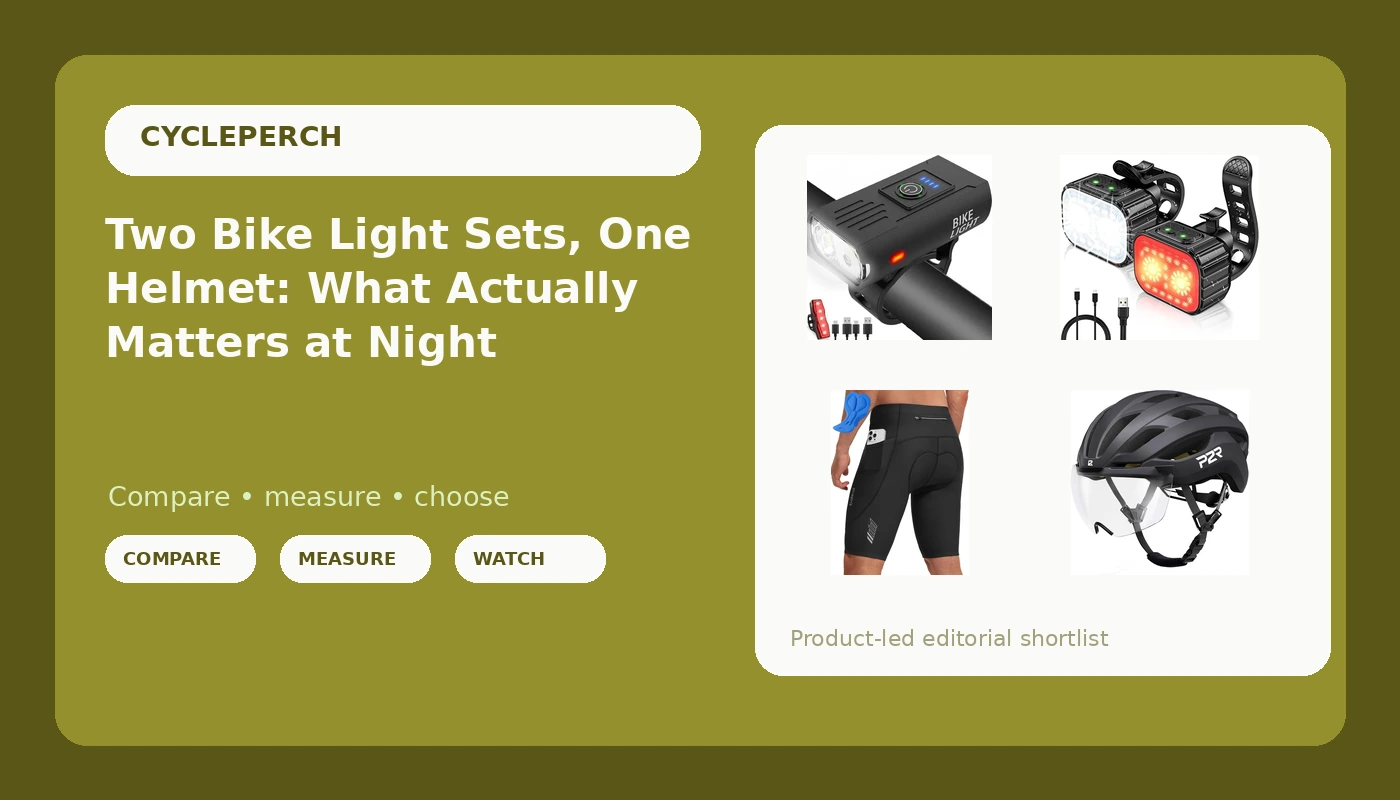
Most night riding gear is sold on numbers you cannot verify from a product page. The box says super bright. The listing says long battery life. The helmet says it has a rear light, and you are left guessing whether any of it survives a real commute at 6 a.m. in the dark. The practical question is not which listing uses the loudest adjectives. It is which pieces you can mount, charge, and wear without fuss, and which ones still make sense after the first month of ownership. This article looks at a rechargeable bike lights set from two different brands, a MIPS helmet with an integrated rear LED, and a pair of padded cycling shorts, and explains what each one actually does for a rider.
The four items here divide the work in a useful way. Lights handle being seen and seeing the road. A helmet handles the part of visibility that does not depend on remembering to charge a second device, and it handles impact protection. Shorts handle comfort, which is the difference between a twenty-minute errand and a two-hour ride you actually finish. Buying them as one bundle is not the point. Understanding which job each one performs is.
Related: How to Aim and Mount Bike Lights for Night Commuting →
Quick answer
Pick the light set that matches how you mount and charge things, add a helmet with a rear LED if you want visibility that does not depend on a separate battery, and treat padded shorts as a comfort layer rather than a safety product. No single item here covers every job. The right choice depends on your bike, your route, and how often you ride after dark.
Four useful options
| Model | Best fit | What stands out |
|---|---|---|
| Victoper Bike Light, High Lumens Super Bright Bicycle Lite, 6+4 Modes USB Rechargeable Bike Headlight & Taillight Set, Waterproof Safety Bike Front & Rearlight for Road, Mountain, Night Riding | Riders who want a matched front and rear pair in a single purchase | A headlight and taillight set together, with 6+4 modes and USB charging |
| Cuvccn Bike Lights Super Bright, Rechargeable Bicycle Lights Set Multiple Modes, Waterproof Bike Lights for Night Riding/Cycling Safety, Front and Back Bike Reflectors Light, Long Battery Life | Riders who want a second set, a spare, or a lower-commitment kit | Front and rear lights in one set with multiple modes and a long battery life claim |
| P2R A20 MIPS Bike Helmet for Teens and Adults with Rear LED Light | Riders who want visibility built into the helmet itself | MIPS construction with a rear LED light integrated into the shell |
| baleaf Men's 4D Padded Bike Shorts Cycling Bicycle Underwear | Riders adding padding underneath shorts they already own | 4D padding in an underwear-style short |
The complete set: Victoper Bike Light, High Lumens Super Bright Bicycle Lite, 6+4 Modes USB Rechargeable Bike Headlight & Taillight Set, Waterproof Safety Bike Front & Rearlight for Road, Mountain, Night Riding
The trade-off with any matched set is that you get one charging system, one set of mounts, and one failure mode. If the rear light dies, you are still riding with a front light, but you are no longer a matched pair, and replacing one half of a kit is often more annoying than replacing the whole thing. On the other hand, a set is the cheapest path to having both ends of the bike covered on day one, and it means you are not hunting for a rear light that fits a mount you already own.
The flexible spare: Cuvccn Bike Lights Super Bright, Rechargeable Bicycle Lights Set Multiple Modes, Waterproof Bike Lights for Night Riding/Cycling Safety, Front and Back Bike Reflectors Light, Long Battery Life
Two light sets is not redundant if you own two bikes, and it is not redundant if you commute on the same bike every day. A charged spare in the bag turns a dead battery from a ride-ending problem into a thirty-second swap. The honest trade-off is that two sets mean two charging cables, two mounting systems, and two things to remember. If you already know you will not maintain that routine, one good set used consistently beats two sets used carelessly.
The visibility layer: P2R A20 MIPS Bike Helmet for Teens and Adults with Rear LED Light
A helmet-mounted rear light sits higher than a seatpost light, which is useful in traffic where the light is competing with taillights from cars for a driver's attention. The trade-off is that you now have one more battery to keep charged, and a helmet light is only as good as your habit of topping it up. Treat it as a supplement to a rear light, not a replacement. And remember that no helmet feature replaces fit. A helmet that sits too high, rocks side to side, or is worn with the straps loose is not doing its job, MIPS or not.
The comfort layer: baleaf Men's 4D Padded Bike Shorts Cycling Bicycle Underwear
The appeal of padded underwear is that it solves a narrow problem: you want to ride your commuter or your town bike in normal clothes, but the saddle starts to hurt past thirty minutes. The trade-off is fit. Padding that bunches, shifts, or holds moisture is worse than no padding at all, so the sizing has to be right and the layer has to sit flat against the skin. Padded liners also do not fix a saddle that is the wrong width or a seatpost that is set too high. Those are position problems, and no amount of foam solves them.
Prices and availability may change. Product images, names, and retailer links must be matched by verified ASIN. Do not state a current price, rating, stock status, or measured result without current evidence.
How to read light specs without a lab
Lumen numbers on a box are a marketing figure, not a measurement, and the gap between the two is often wide. What you can judge without equipment is beam pattern, mounting quality, and how the light is powered. A beam with a hard cutoff and a wide spread lights the road without blinding oncoming traffic; a narrow pencil beam throws a bright spot far down the road and leaves the edges dark. For commuting, the wide pattern matters more than the peak number. For unlit roads at speed, reach matters more.
Run time is the second claim to treat carefully. Battery capacity drops in cold weather, and every mode above the lowest setting eats into the number on the box. If a light's battery is built in and cannot be replaced, the light has an expiration date: when the cell stops holding charge, the product is done. That is worth knowing before you buy, especially at a price point where you would expect a few seasons of use. Waterproofing claims deserve the same skepticism. Look for a stated ingress rating rather than the word waterproof on its own.
Mounts are where cheap lights fail first. A bracket that uses a thin plastic strap, a hinge pin, or a thumbscrew that strips will let the light rotate or drop on the first rough patch. A mount that holds its angle over a pothole is worth more than a hundred extra claimed lumens, because a light pointed at the ground is not lighting anything.
Helmet fit, MIPS, and padding
Head protection starts with circumference. Measure around the widest part of your head with a soft tape, then compare that number to the size chart rather than to a letter you wore in a previous helmet. Cradle adjustment handles the rest: the helmet should sit level, roughly a finger's width above the eyebrows, with the rear cradle snug against the base of the skull. Straps should form a V just below the ear and meet in a buckle that sits flat under the chin. If the helmet shifts when you push it with your palm, it is too loose.
MIPS is a low-friction layer between the liner and the shell, designed to allow a degree of sliding during certain angled impacts. It is one feature among several that matter, alongside fit, coverage, and how well the helmet stays in place. The integrated rear LED on the P2R A20 is a visibility feature, not a protective one, so keep it in its own mental category.
Padded shorts work the same way. The 4D padding in the baleaf liner is there to reduce pressure and friction at the contact points. It cannot correct saddle height, saddle tilt, or a saddle that is the wrong width for your sit bones. Get the position right first, then let the padding handle the remaining discomfort.
- Measure your head circumference and check it against the helmet size chart before ordering.
- Decide whether you want one matched light set or two, based on how many bikes you ride after dark.
- Check the mount design on any light you consider, since brackets fail before LEDs do.
- Confirm whether the light battery is built in or replaceable, and factor that into the price.
- Match padding to your actual ride length, not to the longest ride you hope to do.
Practical guidance
- Charge every light the night before a ride, and keep a spare set charged in your bag during winter.
- Aim the front light slightly down so the beam hits the road, not the eyes of oncoming drivers.
- Run the rear light on a flashing mode in traffic and a steady mode when riding in a group.
- Replace a helmet after a crash, and check the manufacturer's stated replacement guidance for age-related wear.
- Wear padded liners against clean skin, and wash them after every ride or two to keep seams and foam from breaking down.
- Recheck helmet strap tension periodically, since straps loosen with use and heat.
Which option should you choose?
Choose the Victoper Bike Light, High Lumens Super Bright Bicycle Lite, 6+4 Modes USB Rechargeable Bike Headlight & Taillight Set, Waterproof Safety Bike Front & Rearlight for Road, Mountain, Night Riding when you want a matched front and rear pair in a single purchase and a single charging routine. Choose the Cuvccn Bike Lights Super Bright, Rechargeable Bicycle Lights Set Multiple Modes, Waterproof Bike Lights for Night Riding/Cycling Safety, Front and Back Bike Reflectors Light, Long Battery Life when you want a second set for another bike or a charged backup in the bag. Choose the P2R A20 MIPS Bike Helmet for Teens and Adults with Rear LED Light when you want impact protection and helmet-level visibility in one item. Choose the baleaf Men's 4D Padded Bike Shorts Cycling Bicycle Underwear when you ride in everyday clothes and want padding without buying a full cycling short.
None of these four items is interchangeable with the others, and none of them substitutes for the boring work of setting the bike up correctly. A light pointed at the sky, a helmet worn loose, and a saddle set two centimeters too high will all ruin a ride regardless of what the box promised. Fix the setup first, then spend on gear.
The bottom line
Buy the light set you will actually charge, add a helmet that fits and stays put, and treat padding as the last layer of comfort rather than the first line of defense. A matched light set covers both ends of the bike with one purchase and one routine, a second set gives you redundancy, a MIPS helmet with a rear LED folds visibility into protection, and a padded liner makes an existing bike more livable. Read the claims carefully, ignore the loudest number on the box, and spend the difference on the parts that keep the bike running.