Dark arrives earlier than most riders plan for, and a commute or a training loop that used to finish in daylight starts and ends in low light. Night riding cycling gear is the part of the kit list that has to work when you cannot read the road surface and drivers are not looking for you. Most riders solve it with one purchase, a light, and call the job done. That covers being seen at the front. It does not cover the rear, the head, or the contact point that starts complaining at hour two.
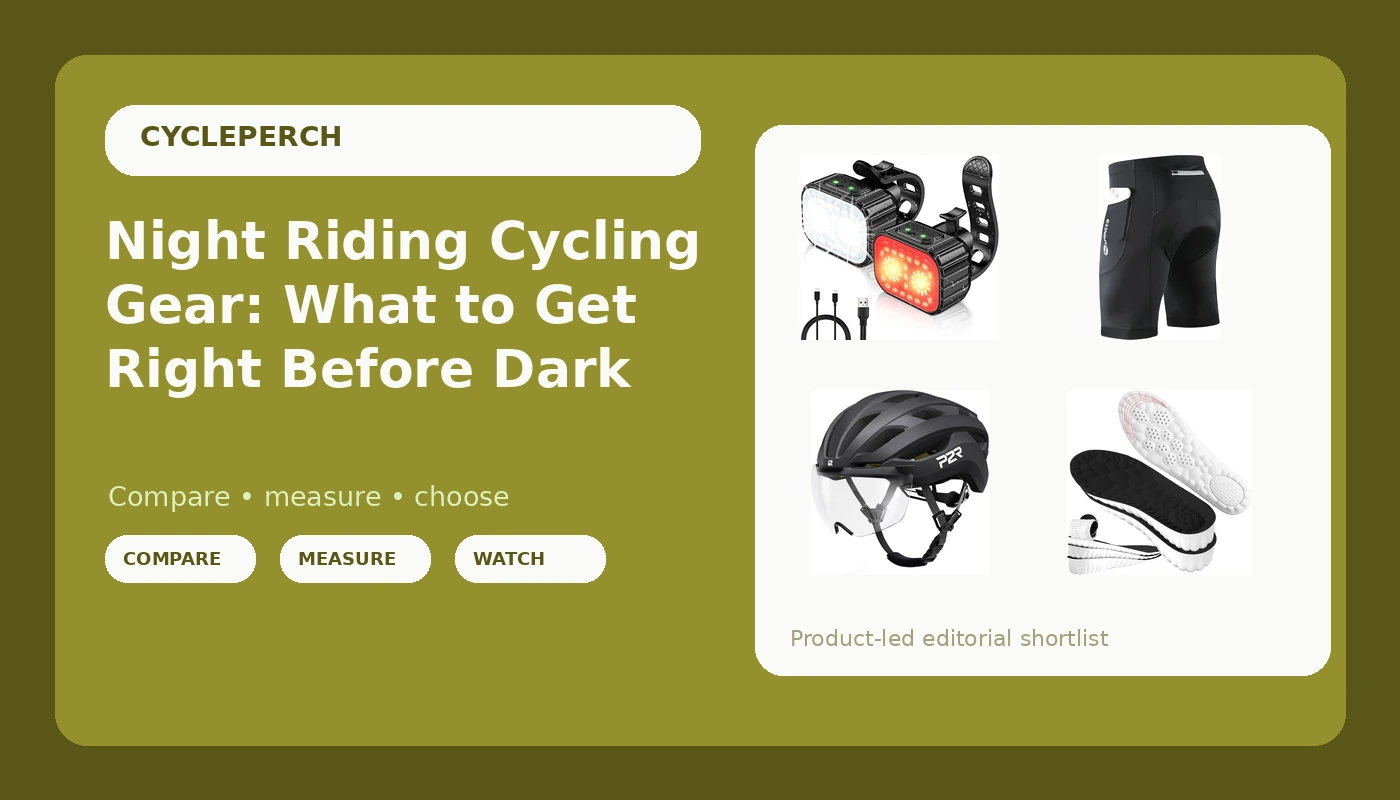
This page covers four items: a rechargeable front and rear light set, padded cycling shorts, a MIPS helmet with an integrated rear LED, and a height-increasing insole that is not cycling gear at all. I would rather say that last part here than have you find out inside a pair of cycling shoes.
Where a number is a manufacturer claim, this page says so. None of these products has been independently measured for this article, and I am not going to pretend otherwise.
Related: How to Set Up Bike Lights for Night Commuting →
Quick answer
Buy the pieces in the order the problem shows up. The Cuvccn set covers front and rear visibility in one purchase and is the first thing to add if your rides now end in the dark. The P2R A20 MIPS helmet covers head protection and adds a second rear light source, which matters on a bike where the taillight is the only thing behind you. The sponeed shorts are the comfort purchase, worth it once rides get long enough that the saddle becomes the limiting factor. The height increase insoles are an off-bike comfort product; they change shoe fit, and they are not cycling gear.
Four useful options
| Model | Best fit | What stands out |
|---|---|---|
| Cuvccn Bike Lights Super Bright, Rechargeable Bicycle Lights Set Multiple Modes, Waterproof Bike Lights for Night Riding/Cycling Safety, Front and Back Bike Reflectors Light, Long Battery Life | Riders who need front and rear lighting from one purchase | Rechargeable front and rear set with multiple modes, a waterproof claim, and reflectors |
| sponeed Men's Cycling Shorts Padded Bicycle Riding Pants Bike Biking Clothes Cycle Wear Tights | Riders adding saddle time who want padding at the contact point | Padded men's cycling shorts in a tights-style cut |
| P2R A20 MIPS Bike Helmet for Teens and Adults with Rear LED Light | Teens and adults who want head protection plus rear visibility | MIPS rotational-impact design with an integrated rear LED |
| Height Increase Insoles for Men, 4D Cloud-Like Memory Foam Height Booster Insoles - Shock Absorbing Trim-to-Fit Steppers Insoles for Confidence & Effortless Comfort (Black, 1.4IN / US M 7.5-10.5) | Comfort and height adjustment in everyday shoes | Trim-to-fit memory foam with a listed 1.4 inch lift |
Front and rear lights: Cuvccn Bike Lights
The set solves the most common gap in a commuter's kit, which is the rear light. A front light lets you see; a rear light lets you be seen, and on a bike the rear is the end traffic approaches from. Two things are worth checking before you buy any light. First, whether the run time claim refers to the mode you will actually use, because claims are often quoted on the lowest output setting. Second, whether the battery is user-replaceable. A light with a sealed battery has an expiration date, and the schedule belongs to the manufacturer rather than to you. Mounting matters too: brackets that clamp with a plastic band and no torque value are the ones I see cracked, so snug them evenly and recheck them after the first wet ride.
Padded shorts: sponeed Men's Cycling Shorts
Padding is the last variable to change, not the first. A chamois helps with friction and pressure at the contact point, but it does not fix a saddle that is the wrong width for you. Sit-bone width is a measurement, and it is the one most riders skip. If your setup hurts after an hour, measure first, then decide whether the fix is padding, saddle width, or position. On care: wash padded shorts inside out, skip the fabric softener, and keep them out of a hot dryer, because heat and softener are what kill the pad and the seams before the fabric wears out.
Helmet: P2R A20 MIPS Bike Helmet
Fit is the part that decides whether a helmet does its job. It should sit level rather than tipped back, with the front edge roughly two fingers above the eyebrows, and the retention dial snug enough that the helmet moves with your scalp when you shake your head. MIPS is a slip-plane system designed to manage rotational forces in certain impacts, and it complements fit rather than replacing it. The integrated rear LED is a real second visibility point, useful on a bike where the taillight sits low and gets blocked by a bag or a jacket. Helmets are single-impact products, so follow the manufacturer's replacement guidance after any crash, and check the production date when you are buying a replacement.
Comfort insoles: Height Increase Insoles
Here is the honest version. Height increase insoles are a shoe-fit and comfort product, not cycling gear, and putting them in a cycling shoe changes two things you set carefully: the volume inside the shoe and the stack height under your foot. Add the listed 1.4 inches of lift and you have effectively lengthened the leg, which means saddle height and cleat position need to be revisited rather than assumed. If your cycling shoes are already snug, a thick insole presses the top of your foot against the upper and creates hot spots. Trim-to-fit means the insole is made for a size range and cut down to your shoe, so measure twice and cut once.
Prices and availability may change. Product images, names, and retailer links must be matched by verified ASIN. Do not state a current price, rating, stock status, or measured result without current evidence.
What to measure before you buy
Visibility is the easiest thing on this list to get wrong, because the number on the box is not the number you ride with. Lumen claims describe output under conditions the manufacturer chooses, and the mode you use most is usually not the mode the headline figure refers to. Two riders can carry the same lumen count and have very different experiences, because beam pattern decides how much of that output lands on the road and how much goes into the trees. A tight hotspot is good for being noticed and poor for seeing surface changes at speed.
Run time is the other claim to read closely. Manufacturers commonly quote the longest figure in the lineup, which is the lowest steady mode. If you commute on a setting bright enough to see by, the number that matters is the run time at that setting, and it is usually a fraction of the headline figure.
Helmet fit is a measurement plus a shape. Head circumference gives you the size range; head shape decides whether that size sits comfortably. A helmet that matches the measurement but not the shape becomes uncomfortable within twenty minutes, and an uncomfortable helmet gets worn loose, which is the failure mode that matters. Replace any helmet after an impact according to the manufacturer's guidance, and check the production date before you buy.
Shorts come down to contact point geometry. Padding thickness is not a quality scale. What matters is whether the pad matches your sit-bone width and your saddle, whether the seams sit where they will not rub, and whether the short stays in place while you pedal. A thick pad in the wrong shape is worse than a thin pad in the right one.
Insoles change shoe volume and stack height. Any insole thick enough to notice shifts where your foot sits, and in a cycling shoe that also shifts the relationship between your foot, the cleat, and the saddle. Trim-to-fit products cover a size range, so the fit you get depends on how carefully you cut.
How to evaluate a claim you cannot test in a store
Most of what you can verify in a shop is fit, and most of what gets marketed is performance. This is the order I use for anything I cannot measure on the spot.
- Write down the claim exactly as printed, including the mode or condition it applies to.
- Decide what measurement would confirm it: output, run time, waterproof rating, or impact standard.
- Check whether the listing or manual names the standard or test method behind the number.
- Identify the wear parts you can replace, such as the battery, mount, strap, pad, or liner.
- Count the installation time before you decide, because a fiddly mount or a trim-to-fit insole costs shop-rate hours you should plan for.
Setting up the kit
- Charge lights after every ride in winter, and keep a spare rear light on the bike for the ride the charge does not cover.
- Aim the front light slightly downward so the hotspot lands on the road instead of in oncoming eyes.
- Recheck light brackets and helmet straps after the first wet ride, because wet plastic and wet webbing are what loosen.
- Fit the helmet level with the retention snug, and run the rear LED on every ride rather than only the dark ones.
- Wash padded shorts inside out in cold water without fabric softener, air dry them, and if you add insoles to cycling shoes, recheck saddle height and cleat position afterward.
Which option should you choose?
Choose the Cuvccn bike lights when your rides now start or end in low light and you do not yet have a matched front and rear set. Choose the P2R A20 MIPS helmet when you need head protection for a teen or adult rider and want a rear light built into the helmet rather than strapped to the seatpost. Choose the sponeed shorts when your distance is climbing and the saddle contact point is what ends your rides early. Choose the height increase insoles when you want a comfort and height product for everyday shoes, and not as a substitute for cycling footwear or a bike fit.
This article describes manufacturer specifications and general shop practice, not measured results. Lumen, run time, and waterproof figures are claims until they are checked against a published standard, and fit depends on your own measurements. Check the current listing for sizing, certification details, and care instructions before you buy.
The bottom line
Night riding gear is a system, and the parts are not interchangeable. A light that lets you see does not do the job of a light that lets you be seen, a helmet only works at the fit you gave it, and padding only helps if the saddle under it is the right width. Buy in the order your rides break: visibility first, then protection, then comfort. The insoles belong in your everyday shoes rather than your cycling shoes, and that is not a knock on them. It is a statement about what they are built for.
Everything above is based on manufacturer specifications and standard shop practice. If a claim matters to you, ask for the standard behind it, measure what you can, and torque the bolts to spec.