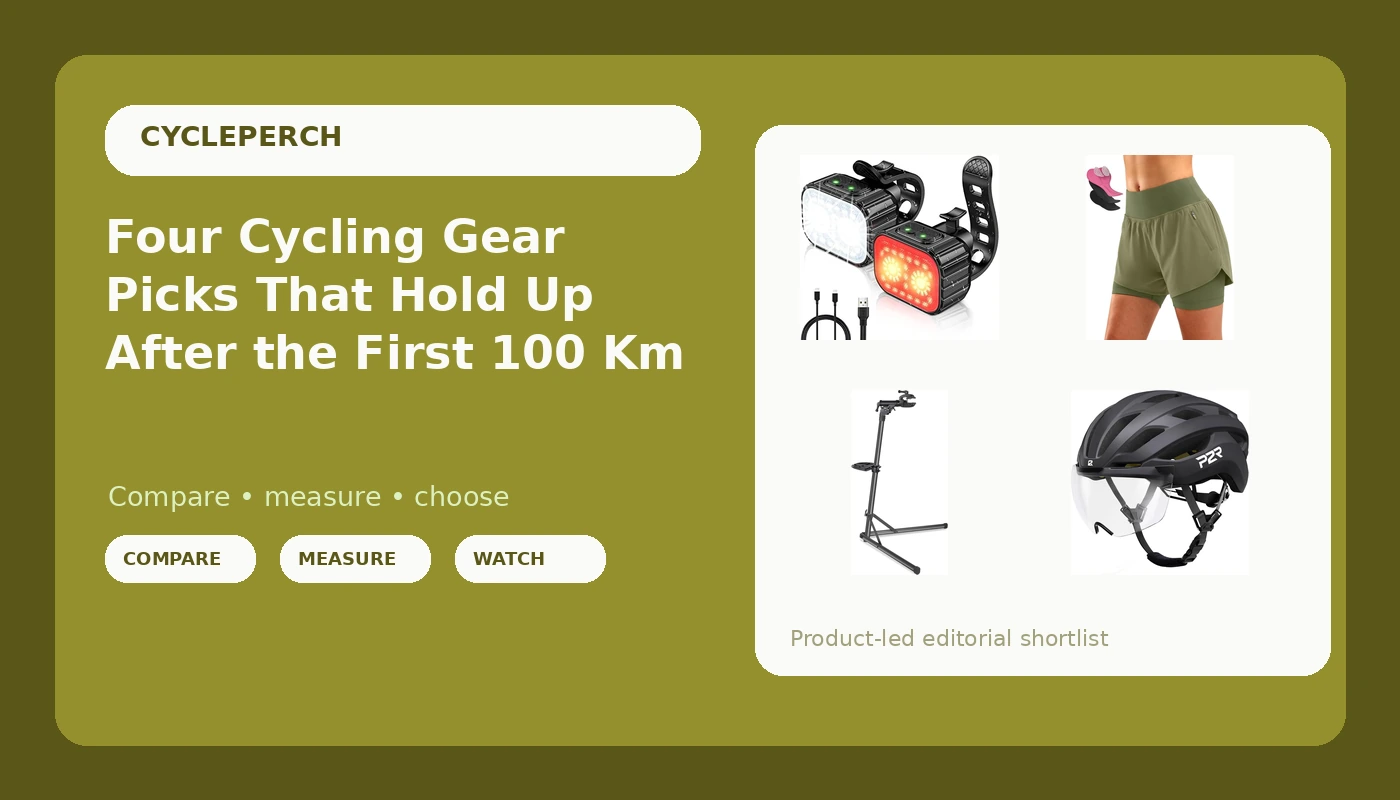
Night riding, home repairs, and long Saturdays in the saddle all ask the same question of your equipment: does it still work when nobody is watching? This guide covers four pieces of essential cycling gear that handle the parts of the hobby riders end up paying for twice, which are light, protection, comfort, and the ability to fix what breaks. A rechargeable light set, a MIPS helmet with a rear light, a pair of padded shorts, and a portable repair stand solve four different problems, and each one has a detail worth checking before you buy. None of them is a race-day upgrade. All of them decide whether a 40-mile evening ride ends with a smile or a phone call for a lift home.
Related: How to Set Up a Home Bike Workshop Without Wasting Money →
Quick answer
For most riders the priority order is lights first, helmet second, then the comfort and maintenance items as budget allows, because visibility and head protection are the two categories where a failure has consequences you cannot undo. A rechargeable front and rear light set covers night riding. A MIPS-equipped helmet with an integrated rear light adds protection and low-profile visibility in a single purchase. Padded shorts with a real chamois make longer rides bearable. A portable repair stand turns routine maintenance from a floor-level wrestling match into a ten-minute job. Buy the one that matches the problem you actually have, then add the rest as the season demands.
Four useful options
| Model | Best fit | What stands out |
|---|---|---|
| BikeHand Bike Repair Stand - Home Portable Bicycle Mechanics Workstand - for Mountain MTB Road Bikes Maintenance - Max. 55 lbs Black | Riders doing their own maintenance at home | Portable workstand design with a manufacturer-stated 55 lb capacity |
| Cuvccn Bike Lights Super Bright, Rechargeable Bicycle Lights Set Multiple Modes, Waterproof Bike Lights for Night Riding/Cycling Safety, Front and Back Bike Reflectors Light, Long Battery Life | Night riding and low-light commuting | Rechargeable front and rear set with multiple modes and reflectors |
| P2R A20 MIPS Bike Helmet for Teens and Adults with Rear LED Light | Teens and adults wanting protection plus visibility | MIPS liner paired with an integrated rear LED light |
| Bikewa Women's Mountain Bike Shorts 4D Padded Cycling Riding Biking Bicycle Biker Cycle Shorts for Women Zipper Pockets | Women riding mountain and mixed terrain | 4D padded liner with zippered pockets |
Workshop anchor: BikeHand Bike Repair Stand
A stand changes what you are willing to attempt. Derailleur indexing, brake bleeds, chain cleaning, and cassette swaps all get faster when the bike is at chest height and you can spin the cranks with one hand. The trade-off is stability versus portability: a folding stand is easier to store, but you should respect the stated load limit and clamp the seatpost rather than a thin-walled frame tube whenever the post is metal. On a carbon post, use the minimum clamp force that holds the bike and let the stand do the work. If you have ever chased a dropped bolt across a garage floor while the bike lay on its side, the stand pays for itself in one afternoon.
Night visibility set: Cuvccn Bike Lights
The number printed on a light box is a marketing number, and the beam pattern is what keeps you alive. A wide, even spread that lights the road edge matters more than a narrow hotspot that throws far and blinds oncoming drivers. Runtime is the second half of the story, and it is the one that changes with temperature: battery capacity drops in the cold, so a light that runs all week in July may need charging every other ride in January. Check that the mount clamps firmly enough that a pothole does not rotate the light into your spokes, and charge both units after every wet ride. A taillight you cannot see from 200 meters back is decoration.
Everyday protection: P2R A20 MIPS Bike Helmet
Fit is the whole job with a helmet. A MIPS liner is worth having, but a helmet that sits too high on the forehead or rocks side to side protects less than a plain helmet that fits correctly. Adjust the retention dial until the shell stays put when you shake your head, then set the straps so the buckle sits just under the jaw and the front strap forms a V under each ear. The integrated rear light is a genuine bonus for dusk commutes, but treat it as a supplement to a proper taillight rather than a replacement, since a small integrated light is not as bright or as long-running as a dedicated unit. Replace any helmet after a real impact, and check the manufacturer's stated replacement guidance rather than relying on memory.
Comfort for the long miles: Bikewa Women's Mountain Bike Shorts
Padding thickness is not the same thing as comfort. A chamois works when its shape matches your sit bones and the shorts stay put, which is why a thinner pad in the right position beats a thick pad that shifts. Wear them without underwear, since seams under a chamois are the usual cause of saddle sores, and wash them after every ride with a mild detergent and no fabric softener, which clogs the pad's foam over time. Zippered pockets are a small feature that matters more than it sounds: on a trail, an open pocket is a lost phone. If you ride both trail and road, one pair of shorts with a removable liner covers more of your calendar than two specialized pairs.
Prices and availability may change. Product images, names, and retailer links must be matched by verified ASIN. Do not state a current price, rating, stock status, or measured result without current evidence.
How to tell whether gear earns its place
The first 100 km tells you whether something works. The next 10,000 tells you whether it was worth buying. That distinction is the whole reason a shop mechanic and a product page disagree so often: a listing describes the product on day one, and a rider lives with it in month eighteen. So the useful question is not "how good is this out of the box" but "what breaks first, and can I replace it." On a light, that is the mount and the battery. On a stand, it is the clamp and the folding joints. On shorts, it is the pad and the stitching. On a helmet, it is the retention system and the straps, which is why you check them before every ride rather than once a season.
Apply the same test to any cycling purchase. Can you measure the claim in some way, whether that means comparing runtime between charges, checking a torque value, or simply noting how often a part needs attention? Does the claim survive the first hundred kilometers of real riding? Is there a spare part available when something wears out, or is the whole unit disposable? Does installation take shop-rate hours you should have budgeted for? Would you trust it on a ride that ends after dark? And does the warranty policy match what the marketing promised? Those six questions filter out most of the gear that looks good in a photograph and disappoints on the road.
What to check before you buy
- Match the product to the problem you actually have, not the problem you might have next year.
- Verify the load or size rating against your own bike or body, since a stated capacity is a limit, not a suggestion.
- Check that consumable or wear parts, such as pads, mounts, and straps, are replaceable or cleanable.
- Read the warranty terms before purchase, because the policy is part of the product.
- Budget for installation and setup time, especially on anything that clamps to the frame or holds the bike off the ground.
Practical guidance for a first setup
- Set your lights to a mode you will actually use on the road rather than the brightest setting, which drains the battery and blinds other riders.
- Recharge both lights after every wet or cold ride, since battery performance drops with temperature.
- Clamp a workstand to the seatpost, not a thin frame tube, and use only enough clamp force to hold the bike steady.
- Fit the helmet with the retention dial and strap adjusters, then recheck the fit once a month as the padding settles.
- Wash padded shorts after every ride with mild detergent, skip the fabric softener, and air dry them rather than using a hot dryer.
Which option should you choose?
Choose the BikeHand Bike Repair Stand when you plan to do your own maintenance and want the bike at working height. Choose the Cuvccn Bike Lights when your riding happens in the dark or in traffic and you need front and rear visibility from one purchase. Choose the P2R A20 MIPS Bike Helmet when you want rotational-impact protection and a bit of built-in rear visibility in a single helmet. Choose the Bikewa Women's Mountain Bike Shorts when longer rides are limited by saddle discomfort rather than fitness.
One caveat on all four: this is guidance based on the specifications and features the manufacturers publish, not a set of measured test results. I have not put these specific units through a lumen test, a load test, or a season of riding, and I will not pretend otherwise. Treat the listed capacities and claims as starting points, then judge the product on how it behaves in your own use, on your own bike, in your own weather.
The bottom line
The gear that lasts is rarely the gear with the loudest numbers on the box. A portable stand, a rechargeable light set, a MIPS helmet with a rear light, and a pair of properly padded shorts cover the four categories where cheap equipment fails at the worst possible moment: in the dark, at the roadside, on a long climb, and halfway through a repair. Buy the one that solves the problem in front of you, check the fit and the ratings before you commit, and keep an eye on the parts that wear, because maintenance is what turns a purchase into an investment. Check current Amazon price on any of them when you are ready to compare.