Every season I see the same thing at the shop: riders buying gear twice. Once at the register, because the spec sheet sounded good, and once more when the thing fails at kilometer 300. The fix is to think about essential cycling gear as a small set of tools that each have one job and do it without drama. A GPS computer that navigates and records, a phone mount that holds your phone through a pothole, and gloves matched to the season and the ride. That is the whole kit. Everything else is a bonus. Here is how I sort the options after years on the bench and 15,000 km a year on the road.
Related: How to Choose a Bike Computer That Survives Winter →
Quick answer
The core set is a compact GPS cycling computer for navigation and data, a twist-lock phone mount for the bars, and two pairs of gloves: one for cold weather and one for warm. The Garmin Edge 850 covers the computer role with button and touchscreen control in a compact body. The Quad Lock Out Front Handlebar Bicycle Phone Mount (V3) is the phone answer for riders who navigate with their handset. The KEMIMOTO Tactical Gloves handle cold-weather and commuter duty on a budget, and the CASTELLI Rosso Corsa Pro Glove is the close-fitting road glove for summer miles.
Four useful options
| Model | Best fit | What stands out |
|---|---|---|
| Garmin Edge 850 | Riders who want navigation and data in one compact unit | Button-plus-touch control and Garmin's mapping ecosystem |
| Quad Lock Out Front Mount (V3) | Riders who navigate with their phone | Twist-lock mechanism built for rough roads |
| KEMIMOTO Tactical Gloves | Commuters and cold-weather riders on a budget | Hard-shell knuckle protection and touchscreen fingertips |
| CASTELLI Rosso Corsa Pro Glove | Road riders who want a close-fitting summer glove | Pro-level palm padding in a minimalist build |
The navigation brain: Garmin Edge 850
The Edge 850 sits in the spot where I tell most customers to look: a computer that does navigation and data without the bulk of a flagship unit. The control layout matters more than the spec sheet. I have replaced forty mounts and serviced computers that died from rain getting into a touchscreen that could not be operated with gloves. A computer with physical buttons for the core functions is the difference between fiddling at a stop sign and riding through it. The 850 keeps the touchscreen for map browsing and keeps buttons for the things you need mid-ride. That is the design decision that earns it a place on the bars.
The phone mount: Quad Lock Out Front Handlebar Bicycle Phone Mount (V3)
Quad Lock is the answer I give for cyclists who ride with their phone. The twist-lock has never let me down on gravel, and I have tried to make it fail. The V3 out-front position is the right one for navigation because it keeps the screen in your peripheral vision without turning your head. The universal adapter matters if you switch phones or run a case that is not Quad Lock's own. I do not recommend rubber-strap mounts to anyone who rides rougher than a bike path. I have seen the aftermath of a phone leaving a strap mount at 30 km/h, and it is not a repair bill I want for anyone.
The budget glove: KEMIMOTO Tactical Gloves
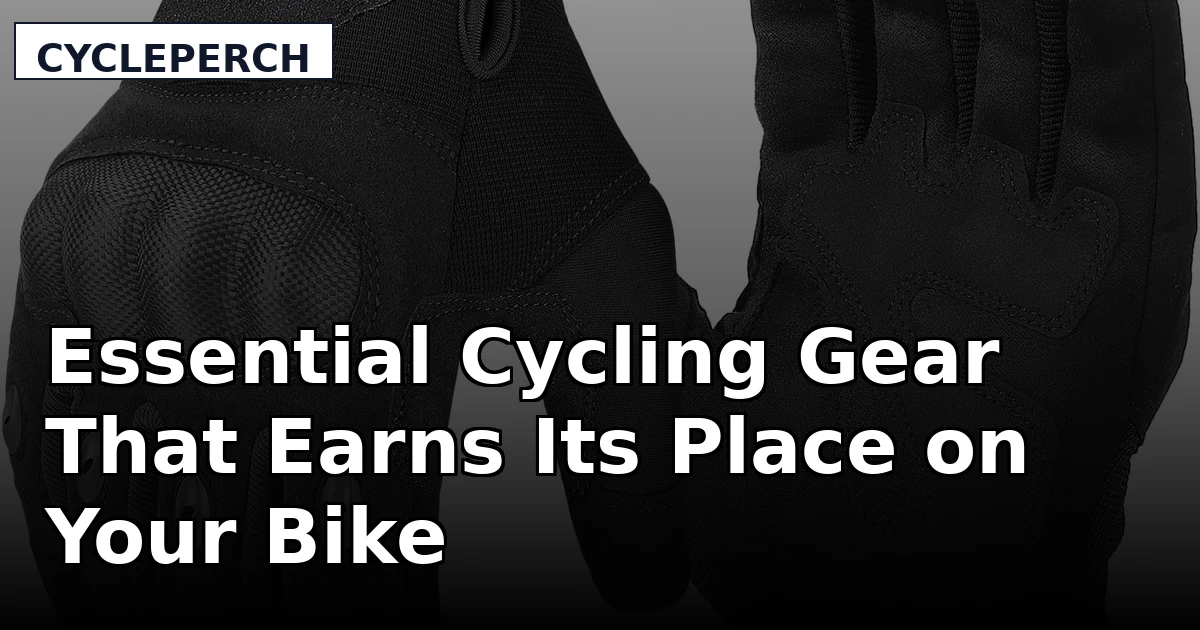
The KEMIMOTO gloves are the budget pick that makes sense for commuters and cold-weather riders who need protection more than race-day feel. The hard shell over the knuckles is real armor, the kind you want if you are splitting lanes or pushing through brush on a mixed-surface commute. Palm padding helps with vibration on rough pavement, and the touchscreen fingertips mean you can answer a call or check a map without pulling a glove off in the cold. They are not a summer road glove, and they are not trying to be. They are the glove you grab when the forecast is ugly and the ride is practical.
The road glove: CASTELLI Rosso Corsa Pro Glove
The Castelli Rosso Corsa Pro is the glove I point road riders toward when they want the close feel of a pro glove without the bulk of a padded commuter mitt. The palm padding is placed where your weight actually lands on the bars, not spread across the whole hand like a cheap gel pad. The fit is the whole story here. A glove that bunches in the palm turns a 100 km ride into a hot spot factory. The Rosso Corsa Pro stays put, which is the job. For summer road riding, this is the glove that disappears on your hands, and that is the highest compliment a glove can get.
Prices and availability may change. Product images, names, and retailer links must be matched by verified ASIN. Do not state a current price, rating, stock status, or measured result without current evidence.
What a GPS computer actually has to do
The spec sheet for a cycling computer is a suggestion. What matters is how the unit behaves on the road. Battery life is the first thing I check, because a computer that dies at kilometer 200 is a paperweight for the last third of your ride. The second thing is control. If you cannot operate the menus with winter gloves or in the rain, the touchscreen is a liability, not a feature. The third is mount security. I have replaced more broken computer mounts than I can count, and the failure is almost always the plastic tab that snaps when you hit a pothole at speed.
GPS accuracy is the fourth thing, and it is where I do my own homework. I run every computer around my 16.2-mile surveyed loop, back to back against a wheel sensor. The loop does not care what the marketing says. A unit that reads 16.31 miles when the loop says 16.20 is telling you something about its filtering, and that matters if you train to numbers. The Garmin Edge 850 sits in the segment of the market where the data is trustworthy enough for serious training and the navigation is good enough to explore. That combination is what most riders actually need.
Gloves are a fit problem, not a brand problem
Glove choice is a measurement problem, and the measurement is your hand. Palm width, finger length, and how the padding sits under your grip all determine whether a glove works. A glove that fits wrong will cause hot spots and numbness no matter how much the brand spent on the fabric. The other variable is the season. A summer road glove is a thin layer of protection and grip. A cold-weather glove has to block wind, manage sweat, and still let you operate brakes and shifters. No single glove does both jobs well, which is why I recommend two pairs: one for the warm months and one for the cold.
Touchscreen compatibility is the modern requirement. You will need to check a map, answer a call, or use a bike computer at some point mid-ride, and pulling a glove off in the cold is how gloves get lost. Both the KEMIMOTO and the Castelli handle this, though in different ways. The KEMIMOTO uses touchscreen fingertips for full phone use. The Castelli is thin enough that you can work a screen through the fabric. The right choice depends on whether you are commuting in the dark or doing summer intervals.
- Measure your hand across the palm at its widest point, excluding the thumb.
- Decide the season first: cold-weather and summer gloves are different tools.
- Check the padding placement against your grip position on the bars.
- Confirm touchscreen compatibility if you use your phone or computer mid-ride.
- Test the brake lever reach with the glove on before you commit.
Building the kit without buying twice
- Start with the navigation layer: either a GPS computer like the Garmin Edge 850 or a phone mount like the Quad Lock V3. Most riders choose one and stick with it.
- If you navigate with your phone, buy the mount that holds it securely. A $12 rubber strap mount is a suggestion box for your phone.
- Buy two pairs of gloves, one for each season, and match them to your actual riding, not to what the pros wear in July.
- Check the mount hardware before you buy. The computer and the phone mount both depend on a bracket that has to survive vibration.
- If you ride in the cold, prioritize gloves you can operate with. A warm glove you cannot shift in is a warm glove that will end up in your pocket.
Which option should you choose?
Choose the Garmin Edge 850 when you want navigation, training data, and a computer that works in the rain without fighting the screen. Choose the Quad Lock Out Front Handlebar Bicycle Phone Mount (V3) when your phone is your primary navigation tool and you need a mount that will not drop it on rough roads. Choose the KEMIMOTO Tactical Gloves when you commute in cold weather or mixed conditions and want hard-shell protection on a budget. Choose the CASTELLI Rosso Corsa Pro Glove when you ride road miles in warm weather and want a close-fitting glove with proper palm padding.
The honest caveat is that no single kit fits every rider. The products here cover the core roles, but the right combination depends on your terrain, your climate, and whether you train to numbers or ride to explore. What does not change is the principle: buy gear that has one job and does it well, and you will not be buying it twice.
The bottom line
Essential cycling gear is a small set of tools, each with a clear job. A compact GPS computer like the Garmin Edge 850 handles navigation and data without the bulk of a flagship. A twist-lock phone mount like the Quad Lock V3 holds your phone where you can see it and keeps it there. Two pairs of gloves, the KEMIMOTO for cold and the Castelli for warm, cover your hands across the seasons. That is the kit. It is not glamorous, but it is honest, and it will get you through the year without a second trip to the register.